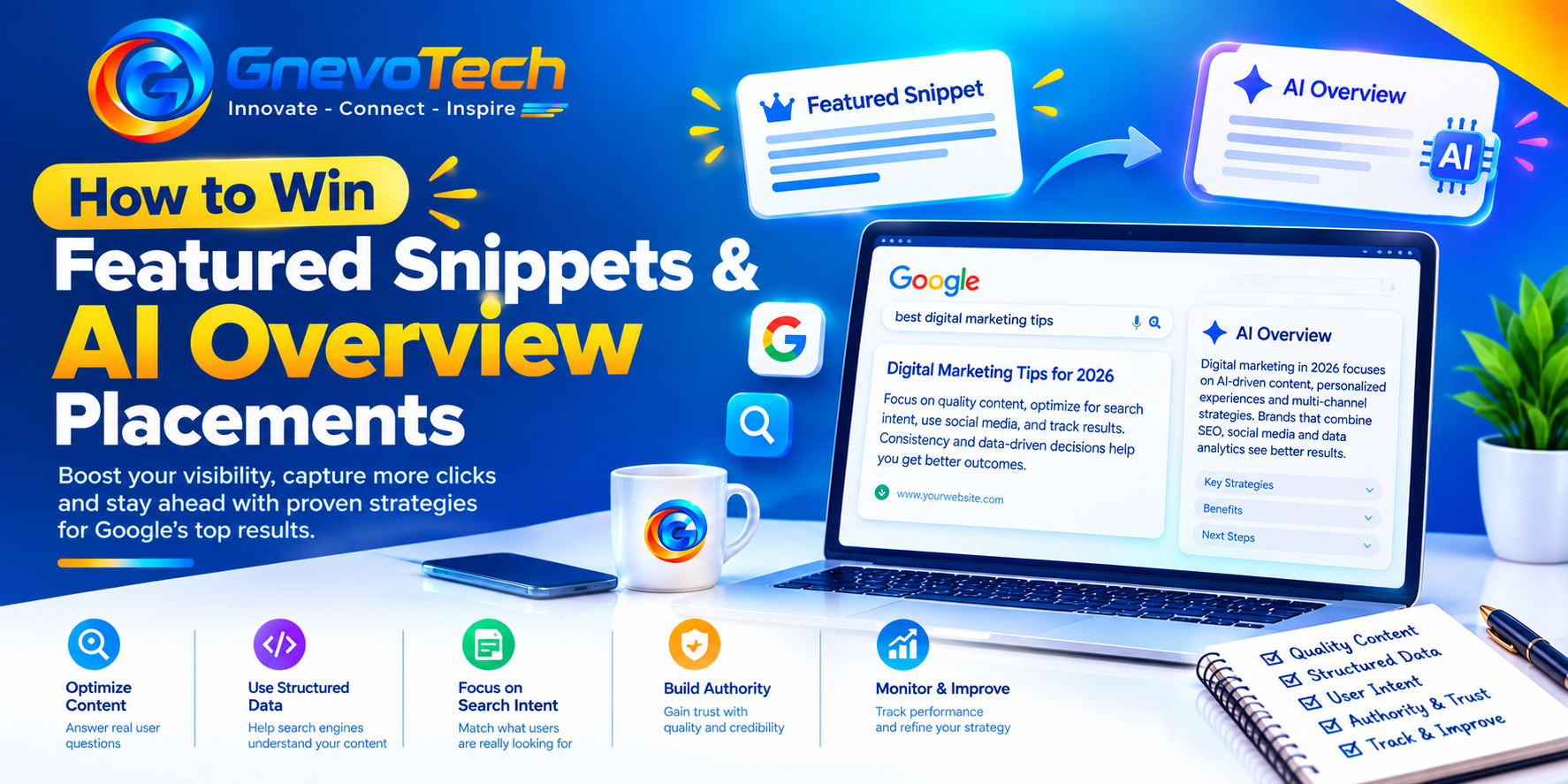
Position zero used to mean one thing: the boxed answer sitting above the first organic result on Google. In 2026, that space has a new neighbour. AI Overviews now sit above featured snippets on a large share of informational searches, and both surfaces reward the same underlying skill — giving Google a clear, extractable answer before anything else. At Gnevotech, this is one of the most practical wins we deliver for clients, because the changes required are often small, specific, and fast to implement.
This guide walks through exactly how featured snippets work, the four formats Google pulls from, and the structural choices that help a page win both the snippet box and an AI Overview citation.
What a Featured Snippet Actually Is
A featured snippet is a single page’s content elevated above the regular search results, with the source link shown beneath it. Google extracts a paragraph, list, table, or short video clip directly from a page and displays it as the answer to a search query.
A few structural facts shape how we approach this work:
- Only one URL wins a snippet at a time. Every other ranking page on that query misses out on the click.
- Snippet selection is partly independent of ranking position. A page sitting outside the top ten organic results can still win the snippet if its answer is formatted better than the competition.
- Snippets shift often. A page holding position zero today can lose it within weeks if a competitor publishes a cleaner answer.
How Featured Snippets and AI Overviews Relate
The two surfaces are often confused, but they work differently.
A featured snippet pulls a direct answer from a single source and displays it with that source clearly credited. An AI Overview synthesises information from several sources into one generated response, sometimes citing multiple pages within the same summary.
Despite this difference, the content patterns that win one tend to win the other. A page written to satisfy a featured snippet — clear, direct, well-structured — is also far more likely to get pulled into an AI Overview. This overlap is exactly why we treat snippet optimisation and AEO Services as one connected effort rather than two separate projects.
The Four Featured Snippet Formats
Google selects snippets from four recognisable formats, and knowing which one fits a query is most of the battle.
Paragraph Snippets
The most common format by far, covering the majority of all snippets. These appear for questions starting with “what is,” “why does,” “how does,” and similar definitional phrasing.
Winning pattern: open the relevant section with a 40 to 60 word answer that stands on its own, with no throat-clearing or setup beforehand. State the answer first, then expand with supporting detail.
List Snippets
Triggered heavily by “how to” queries, list snippets pull either a numbered sequence or a series of heading-based steps.
Winning pattern: use genuine HTML ordered or unordered lists, not paragraphs dressed up with dashes. Keep each step short, action-focused, and free of unrelated detail.
Table Snippets
These appear for comparison-style queries — pricing tiers, feature comparisons, specification breakdowns.
Winning pattern: use a real semantic HTML table rather than an image of a table or a table built from styled divs. Google needs to read the rows and columns directly to extract them.
Video Snippets
Less common for most business categories, but relevant for tutorial-style content. Google pulls a short clip and timestamp directly tied to the query.
Winning pattern: add clear chapter markers and a transcript, since both help Google match a specific moment in a video to a specific question.
The Content Pattern That Wins Both Surfaces
Across all four formats, one pattern repeats consistently in the pages that win.
- Phrase the heading as the question itself. A heading written as “What Is Answer Engine Optimization?” matches how people search far more closely than a vague or clever heading.
- Answer within the first sentence or two. Google and AI systems both reward content that resolves the question immediately, before adding context.
- Keep the answer self-contained. A snippet-worthy passage should make sense even without reading the rest of the page.
- Support the answer with evidence. A specific number, timeframe, or named example strengthens both the snippet and the trust signal AI systems look for.
- Update the page regularly. Stale answers lose ground to competitors publishing more current information, particularly on topics tied to prices, dates, or statistics.
Technical Steps We Apply for Clients
Beyond writing, several technical choices influence whether a page is even eligible to be pulled into these surfaces.
- Clean semantic HTML. Proper heading tags, list tags, and table tags give search engines a reliable structure to extract from.
- FAQ and HowTo schema markup. Structured data does not guarantee a snippet, but it gives Google and AI crawlers an unambiguous map of question-and-answer content.
- Fast page load times. Both Googlebot and AI crawlers deprioritise pages that are slow to render or block automated access.
- Clear internal linking. Pages that are easy to find and well-connected within a site tend to get crawled and re-crawled more often, which matters for snippet freshness.
Our AI SEO Services cover this technical layer as standard, since none of the content-level work above performs consistently without it.
Finding the Right Opportunities to Target
Not every keyword is worth chasing for a snippet, and choosing the right ones saves significant time.
- Target queries where a snippet already exists. If Google is already showing a snippet for a query, that confirms the format Google prefers for it.
- Check whether the current snippet is weak. A thin, outdated, or poorly formatted existing snippet is often easier to outrank than a genuinely strong one.
- Cross-check the same question inside an AI assistant. If ChatGPT or Perplexity gives a noticeably better or different answer than the current snippet, that gap signals an opportunity worth targeting.
- Prioritise questions your business already answers well. A page already ranking on page one for a related term has a real chance of capturing the snippet with structural changes alone, without new content from scratch.
Common Mistakes That Cost Businesses the Snippet
A few recurring issues explain why many otherwise strong pages fail to win position zero.
- Burying the answer under a long introduction. Google rarely selects an answer that requires scrolling past several paragraphs of setup.
- Formatting lists as plain paragraphs. A numbered process written as flowing prose loses its list-snippet chances entirely.
- Skipping schema markup. Pages without FAQ or HowTo markup miss an easy, low-cost signal that helps both snippets and AI Overviews.
- Letting content go stale. A page that once held a snippet can quietly lose it if a competitor publishes fresher, better-supported information.
- Writing for keywords instead of the actual question. Content built around a keyword phrase rather than the specific question behind it tends to underperform in extraction, even when it ranks well.
How Gnevotech Builds This Into Client Work
As an AI SEO Agency in Jaipur, we treat snippet and AI Overview optimisation as part of a single, ongoing process rather than a one-time formatting pass.
Step 1 — Opportunity Mapping We identify existing rankings where a snippet or AI Overview is already present, and flag the ones most winnable.
Step 2 — Answer-First Rewriting We restructure the relevant section of each page so the direct answer appears immediately, in the format Google already favours for that query.
Step 3 — Schema Implementation We add FAQ, HowTo, or table markup depending on the content type, giving both Google and AI crawlers a clear structure to extract.
Step 4 — Technical Cleanup We confirm crawlability, page speed, and semantic HTML are not blocking extraction, since even perfectly written content can be skipped over technical faults.
Step 5 — Monitoring and Defence We track snippet ownership and AI citation frequency over time, since both can shift quickly if a competitor improves their own content.
This process sits alongside our broader SEO Services in Jaipur and GEO Services, since snippet-winning content strengthens visibility across every one of these surfaces at once.
Tools We Use to Track Performance
Winning a snippet or an AI Overview citation is only useful if a business can see whether it holds, so measurement matters as much as the initial win.
- Rank tracking tools with SERP feature detection show which of our target keywords currently display a snippet, and which URL holds it.
- AI citation tracking platforms monitor when and how often a domain gets referenced across tools like ChatGPT, Perplexity, and Gemini for relevant queries.
- Search Console query data reveals impressions and clicks tied to specific questions, which helps confirm whether a snippet win is actually translating into traffic.
- Manual spot checks inside AI assistants remain useful even with automated tools in place, since asking the exact target question directly shows precisely what a real user would see.
We review this data on a recurring basis rather than treating a snippet win as a finished task, since both Google’s snippet selection and AI citation patterns shift as competitors publish new content.
Why Timing Matters More Than It Used To
Snippets and AI citations reward freshness more heavily than standard organic rankings do. A page that held a snippet for a year can lose it within days if a competitor publishes an updated, better-supported version of the same answer.
This changes how often content needs review. Where a standard blog post might get revisited annually, a page actively holding a valuable snippet or AI citation benefits from a lighter, more frequent check — confirming the answer is still accurate, the supporting data is current, and no competitor has published a cleaner version of the same structure.
Businesses that treat this as ongoing maintenance rather than a one-time win tend to hold their placements far longer than those that move on after the first success.
A Practical Example
A client offering equipment calibration services previously ranked on page one for “what is calibration management software” without holding the snippet. The existing top result buried its definition three paragraphs deep, behind a lengthy introduction.
Restructuring the page so the definition appeared in the first two sentences, formatted as a clean paragraph directly under a matching H2, moved that page into the snippet within a few weeks, without any change to the page’s overall ranking position. The same restructuring also began appearing as a cited source inside AI Overview responses for closely related queries.
Frequently Asked Questions
Do featured snippets still matter with AI Overviews taking over search results?
Yes. Featured snippets still appear on a meaningful share of informational queries, particularly where no AI Overview is present, and they continue to drive strong click-through when they do. Even where an AI Overview appears above them, the same content patterns tend to feed both surfaces.
How long does it take to win a featured snippet?
Timelines vary by competition and query difficulty, but well-executed structural changes on an already-ranking page often show movement within a few weeks, since snippet selection can shift faster than overall rankings.
Can a smaller business compete for these placements?
Yes. Snippet selection is partly independent of overall domain authority, which means a well-structured answer from a smaller site can outrank a larger competitor’s poorly formatted page on a specific query.
Do I need schema markup to win a snippet?
Schema markup does not guarantee a snippet on its own, but it removes ambiguity for search engines and AI crawlers, which makes winning one considerably more likely alongside strong content structure.
Conclusion: Earning the Answer, Not Just the Ranking
Winning a featured snippet or an AI Overview citation rarely requires a complete content overhaul. It requires giving Google and AI systems exactly what they are already looking for — a clear, self-contained answer, formatted in the structure each surface prefers, backed by clean technical execution.
We help businesses identify these opportunities and apply the specific formatting, schema, and technical changes needed to capture them. If your business is ready to move beyond ranking and start owning the answer itself, our team at Gnevotech is ready to build that plan with you.