
A founder in Jaipur who sells silver jewellery bought three country domains in one weekend, one each for Germany, the UK and the UAE. By Monday he was proud. By March he had three half-empty websites to update, three sets of plugins to renew and almost no traffic on any of them. Nobody had told him that the structure itself is a decision with consequences. Plenty of exporters start looking at global SEO services after a moment like this, but this choice is one you can understand yourself before paying anyone.
Here’s how we’d work through it, one option at a time.
The short version, and one honest note
If you only have a minute:
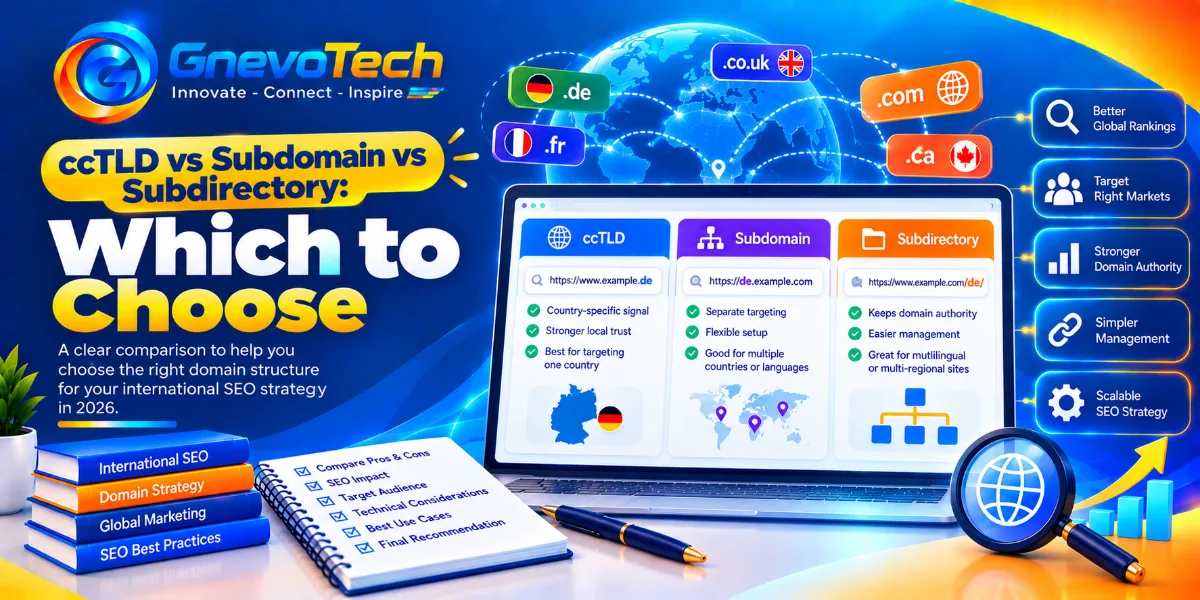
- An ccTLD is a country domain, such as yourbrand. de
- A subdirectory is a folder on your main site, such as yourbrand.com/de/.
- A subdomain is a separate section, such as de.yourbrand.com
- Country domains send the clearest local signal but cost the most effort
- Subdirectories are usually the simplest and cheapest to manage
- Subdomains suit separate setups and are rarely the first pick for beginners
- Your budget, team and plans matter more than any rule
The honest note: nobody can promise a ranking, and we won’t. Positions depend on competition, your site’s history, links from other sites and how searchers behave. Search engines also update their guidance now and then, so check their official help pages before you commit.
The three options in plain words
Think of your website as a shop and each market as a branch.
- An ccTLD is a separate shop with its own address in each country
- A subdirectory is one big shop with a clearly labelled floor for each country
- A subdomain is a shop in the same building but with its own entrance and its own staff
All three can work. They simply ask for different amounts of money, time and technical care.
Option 1: ccTLD (country domain)
This is the option with the clearest local message. A .de or .co.uk address tells both shoppers and search systems that the site is meant for that country.
What it does well:
- Builds quick trust with local buyers, who often prefer a familiar ending
- Makes your target country obvious
- Lets you adapt the site fully to each market
What to watch out for:
- Every domain is a separate site that has to earn its own authority
- Hosting, security, updates and content all multiply
- Some country domains have local rules, such as needing a business address there
- Costs grow with every market you add
This is a good fit when you’re committed to a few important markets and have the people to run each one properly.
Option 2: Subdirectory (folder on one domain)
Here everything lives under one domain, with each market in its own folder, like yourbrand.com/uk/ or yourbrand.com/ae/.
What it does well:
- One domain means one place to manage and one set of authority to build
- Setup and upkeep are simpler
- Cheaper to start, and easy to add a new market later
- Fewer moving parts for a small team
What to watch out for:
- The local signal is less obvious than a country domain, so you rely on good structure and clear markers
- A problem on the main site can affect every folder
- Each market’s content still has to be genuinely local, not a copy
For many small and mid-sized businesses, this is the most practical place to begin. Businesses that want planning help to set it up properly often compare international SEO services, and the best conversations start with the structure, not with a price.
Option 3: Subdomain
A subdomain is a separate section that sits in front of your main domain, like uk.yourbrand.com.
What it does well:
- Allows a separate technical setup, such as different hosting or a different platform
- Useful when a market needs a very different site
What to watch out for:
- Search systems often treat subdomains more separately than owners expect, so you may not share authority as neatly as with folders
- You still manage multiple setups
- It’s an easy choice to make for the wrong reasons, such as a developer’s habit
It makes sense in specific cases. For a first international move, it’s rarely the simplest answer.

Side by side
| Point | ccTLD | Subdirectory | Subdomain |
| Local signal | Strongest | Moderate, needs support | Moderate |
| Setup effort | Highest | Lowest | Medium to high |
| Ongoing cost | Highest | Lowest | Medium |
| Shares authority | No, each site builds its own. | Yes, with the main domain | Often treated more separately |
| Best for | A few committed markets | Most growing businesses | Separate platforms or teams |
Treat the table as a starting point. Your situation can change the answer.
How to decide: five questions
Try answering these on paper.
- How many markets will we serve in the next two years?
- Do we have people to run, update and write for each site?
- Will each market need its own pricing, platform or legal setup?
- How much budget can we spend before we see results?
- Do our buyers care about a local-looking address?
If your answers are “a few markets, a small team, a modest budget,” subdirectories usually fit. If they’re “three key markets, a dedicated team, local legal needs,” country domains may be worth the extra effort.
Whichever you pick, set it up properly
The structure is only the container. These habits matter on all three options.
- Hreflang tags: a small piece of code that tells search engines which page version is for which language and country. Every version should point to the others and back to itself
- Genuine localization: local currency, delivery details, local spellings and real local phrases, not word-for-word translation
- Clear internal links: make it easy for a visitor to switch country, and don’t force them
- One clear page per purpose: avoid several near-identical pages competing with each other
- Speed: a site that loads fast in Jaipur can feel slow in Frankfurt, so test from the places your buyers live
Hreflang is one of the technical areas where small typos cause big confusion. A specialist can save time here, and some owners look at international SEO services in Jaipur to set it up and check it regularly. Ask the provider to explain, in writing, what they’ll change and how they’ll test it.
Moving from one structure to another
Migration is where rankings can wobble. If you already have a site and want to change, plan it like a house move.
- Make a full list of your current addresses
- Map every old address to its new one with permanent redirects
- Keep titles, descriptions and strong content intact
- Test everything before launch
- Watch your search data closely for several weeks
Don’t switch structures just because someone online called it “better.” Move only when you have a real reason, such as a new market, new team or a technical limit.

Mistakes we see all the time
- Buying several country domains before there’s a plan to run them
- Choosing subdomains because a developer preferred them
- Copying the English site into a new folder and calling it localized
- Setting up hreflang once and never checking it
- Moving structures without a redirect plan
- Targeting too many countries at once
- Expecting results in a few weeks
Most of these come from impatience. Steady, honest work tends to win.
AI answers and what stays the same
More people now ask an AI assistant a question and read a single written reply, in many languages. Whatever structure you pick, the habits that help are the ones that already help people: clear pages, consistent business details across the web, honest reviews and content that’s easy to understand. Nobody can promise that a particular page will be quoted, but you can make your site hard to misread.
Claims worth treating with care
You’ll see plenty of agencies calling themselves number one. When you come across the best international SEO agency in Jaipur, treat the phrase as a reason to ask more questions, not as proof. Read real case studies, speak with a past client if you can and get the terms in writing. Be careful with guaranteed rankings, instant results or a quote that doesn’t say what’s included.
A thirty-day starting plan
You don’t need a big budget to begin.
- Week one: List your current countries, orders and inquiries, then pick one or two target markets
- Week two: Compare the three structures against the five questions above and write down your choice and your reasons
- Week three: Build or improve one localized page set with correct currency, delivery and contact details
- Week four: Set up hreflang, test speed from your target countries, and start tracking results by country
Then repeat, one market at a time.
Conclusion: Choose the Structure You Can Run Well
A country domain, a subdirectory and a subdomain can each work. The best one is the one you can keep up, afford and explain to your team. Start with the markets that matter, set up localization and hreflang carefully, and measure results by country. Treat anyone who promises certainty with caution.
At Gnevotech, we help businesses make clear, practical choices about international SEO, so growth in new countries rests on solid foundations and not on shortcuts.
Frequently Asked Questions
1. Which structure is best for a small business?
For many small businesses, subdirectories are the simplest and cheapest to manage. The right choice depends on your markets, team and budget, so compare all three before deciding.
2. Do country domains rank better than subdirectories?
Not automatically. A country domain sends a clear local signal, but each one has to build its own authority. A well-run subdirectory setup can perform very well.
3. Can I mix structures on one site?
It’s possible, but it adds complexity. Most businesses do better with one consistent approach, unless a specific market truly needs a different setup.
4. Will changing my structure hurt my rankings?
It can, if redirects and tags are handled badly. Plan the move carefully, keep strong content and watch your data closely for several weeks afterwards.