
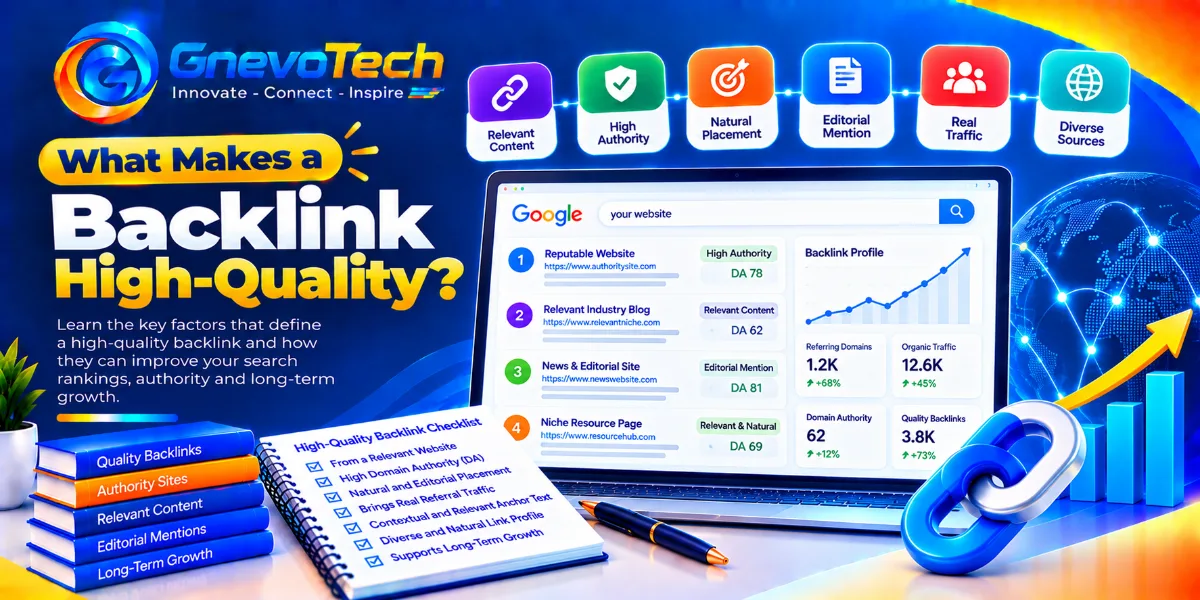
A coaching center owner in Jaipur once showed us a proud screenshot. A site with a very high “authority score” had linked to his page. He’d paid a small fee for it, and the number next to the site name looked impressive. When we opened the page, it sat among articles about online betting, loan offers and cheap watches. His inquiries didn’t move. They dipped a few weeks later. He had chased a score when he needed a recommendation. Many owners in his position start asking about off-page SEO services, but the first skill to learn is how to judge one link yourself.
Here’s the test we use, one signal at a time.
The short version, and one honest note
If you only have a minute:
- A good backlink is a real recommendation from a relevant, trusted page
- Relevance and trust matter more than any score from a tool
- Placement inside useful content beats a link dropped in a footer or list
- Real readers on the linking page are a good sign
- A few strong links outweigh a pile of weak ones
The honest note: nobody can promise a ranking, and we won’t. Links are one signal among many, alongside content quality, relevance and technical health. Google also updates its guidance, especially on link spam, so check its official help pages before you act.
Quality means trust, not a number
Tool companies publish scores such as Domain Authority or Domain Rating. They can be handy for comparing sites, but Google does not produce or use them. A high number can sit on a site with poor content, and a low number can sit on a small local site your customers genuinely trust.
Treat scores as a rough hint, never as the verdict. The better question is simple: would a real person, reading this page, be right to follow the link?
Signal one: relevance
A link makes the most sense when the two pages share a topic or a place. A Jaipur interior designer linked from a home-decor blog is natural. The same designer linked from a page about crypto tips is odd, and odd looks suspicious.
Ask these questions:
- Does the linking site cover a topic close to yours?
- Does the specific page match the page it links to?
- Is the audience likely to care about what you offer?
- If the audience is local, is the site local too?
Relevance isn’t only about keywords. It’s about whether the link makes sense to a human.
Signal two: the trustworthiness of the source
A link borrows some trust from the page it sits on. So look at that page honestly.
- Is it a real site with a named owner, contact details and original content?
- Does it have actual readers, such as comments, shares or regular updates?
- Does it link out only to sensible places, or to anything for a fee?
- Is it free of obvious spam, such as pop-ups, thin pages and unrelated ads?
A site you’d be happy to show a customer is usually a good source. A site you’d rather not explain is usually a bad one.
When a specialist helps
Some owners do all this themselves. Others lack the time, the contacts or the patience to check dozens of sites. If you’re comparing an off-page SEO agency in Jaipur, a few plain questions keep the conversation honest.
- Can you show real links you’ve earned for businesses like mine, with context?
- How do you decide which sites are worth approaching?
- Do you ever buy links, and what’s your policy on that?
- What will I receive each month, in plain terms?
- What can’t you control?
A good provider answers calmly and admits uncertainty. A weak one leans on scores and guarantees.
Signal three: placement inside real content
Where a link sits tells you how much it means. A link inside a helpful paragraph, where the writer is pointing readers to something useful, is a genuine recommendation.
| Placement | Usually worth | Why |
| Inside a relevant article, in context | High | Reads as an honest recommendation |
| In an author bio or credited source | Good | Shows a real relationship |
| In a long list of sponsors or partners | Moderate | Fine if real, weak if padded |
| In a footer or sidebar across the whole site | Low | Appears everywhere, says little |
| In a comment or a forum signature | Very low | Easy to abuse |
Treat the table as a guide, not a law. A single natural mention in a respected article can outweigh dozens of footer links.
Signal four: the words around the link
The clickable text, called anchor text, and the sentence around it give context. Natural anchors look like what a person would write: the brand name, a page title, or a short plain phrase.
- Brand and page-name anchors look natural
- Occasional descriptive phrases are fine
- A long run of identical, keyword-packed anchors looks engineered
- Surrounding sentences should make sense without the link
If every link to your site uses the same commercial phrase, that pattern can look manipulated. Variety reads like real life.
Signal five: real readers and real visits
A link that sends no one anywhere is a weaker sign than one that people actually click. You can’t always see this, but you can look for clues.
- Is the linking page recent, or abandoned for years?
- Does the site publish regularly and attract comments or shares?
- Does the page appear in search results for anything?
- Do you see referral visits from it in your analytics?
A smaller site with a loyal audience often sends better visitors than a big site nobody reads.
Using your Jaipur advantage
Local relevance is one of the strongest quality signals a small business can earn. A mention from a Jaipur trade body, a college you work with, a craft fair or a city magazine tells readers and search systems that you’re a real business in a real place.
Businesses that want help finding and approaching these sources sometimes look at off-page SEO services in Jaipur. Ask the provider to explain their method in writing and show similar work before you agree to anything.
Do follow, nofollow and the labels in between
Links can carry labels that tell search systems how to treat them. Google describes “nofollow,” "sponsored," and "UGC" for links that are paid for, user-generated, or not meant to pass endorsement.
- Paid or sponsored links should be labelled honestly
- Links in comments and forums are often labelled as user-generated
- A labelled link can still send visitors and build awareness
- Don’t judge a link only by its label
A nofollow link from a trusted local newspaper may be worth more to your business than an unlabelled link from a nobody. Quality is the whole picture.
Red flags worth noticing
Some patterns suggest a link isn’t worth having.
- The page exists mainly to sell links
- The site covers every topic, from casinos to cooking to cars
- The link sits in an unrelated article that feels forced
- The text around it is awkward or clearly machine-written
- The same site links out to hundreds of unrelated businesses
- You were offered it for a fixed price per link, with no explanation
If you wouldn’t be comfortable explaining a link to a customer, don’t keep it.

A quick scorecard you can use
Give each link a mark for the five signals, from zero to two.
- Relevance: Does the topic or location fit?
- Trust: Is the site real and respectable?
- Placement: Is the link inside genuine content?
- Anchor: Does the text look natural?
- Audience: Does the page have real readers?
A link that scores high on most is likely worth keeping. A link scoring zero on two or three should be questioned. The scorecard is rough, and judgement matters, but it forces you to look past the shiny number.
Claims worth treating with care
You’ll see plenty of agencies calling themselves number one. When you come across the best off-page SEO agency in Jaipur, treat the phrase as a reason to ask more questions, not as proof. Read real case studies, speak with a past client if you can and get terms in writing. Be careful with guaranteed rankings, a fixed number of links per month or quotes that don’t say what’s included.
Mistakes we see all the time
- Trusting a tool score as the whole story
- Buying links in bulk because the price looks low
- Pointing every link at the home page
- Using the same exact anchor text again and again
- Never checking who actually links to you
- Ignoring unnatural links that appear suddenly
- Expecting results within a few weeks
Most come from impatience. Steady, honest work tends to win.
A thirty-day starting plan
You don’t need a big budget to begin.
- Week one: List the links you already have and score a sample of twenty using the five signals
- Week two: Note any that look weak or unnatural, and decide which to leave alone and which to question
- Week three: Pick two or three pages worth linking to and improve them, then list ten relevant, trusted sites for outreach
- Week four: Send a few personal messages, check referral visits and note what you learned
Then repeat the cycle each month.
Conclusion: Judge Links Like a Customer Would
A high-quality backlink is a believable recommendation from a relevant, trustworthy page, placed naturally and read by real people. Scores can help, but they never replace judgment. Look at relevance, source, placement, anchor text and audience, and treat quality as more important than totals. And be wary of anyone who promises certainty in a field that keeps changing.
At Gnevotech, we help businesses earn links the honest way, so visibility grows from solid foundations and not from shortcuts.
Frequently Asked Questions
1. What is a high-quality backlink?
It’s a link from a relevant, trustworthy site, placed naturally inside useful content and likely to be seen by real readers. It acts as a genuine recommendation for your page.
2. Do tool scores like Domain Authority decide quality?
No. They are created by tool companies, not by Google, and can be useful as a rough hint. Relevance, trust and natural placement matter more.
3. Are nofollow links worthless?
Not necessarily. They may pass little ranking value, but they can still send visitors and build awareness, especially from trusted sites.
4. How many quality links do I need?
There’s no magic number. A small set of relevant, genuine links usually beats a large pile of weak ones, and the right amount depends on your competition.