
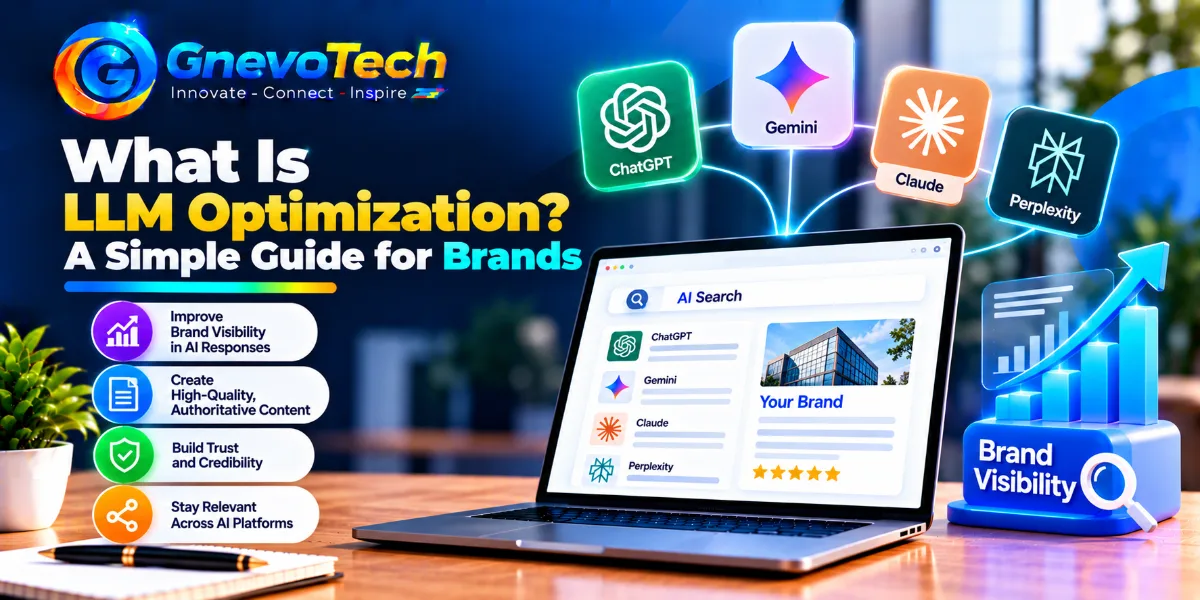
A café owner in Jaipur told us a customer had walked in and said, “The AI told me to try your cold coffee.” She was thrilled, then curious. She had never done anything to appear in an AI answer, and she had no idea why it had picked her. Brands are asking the same thing in a more worried tone: how do we get named when someone asks a chatbot for a recommendation? Many start looking at LLM optimization services at this point, but the basics are simpler than the jargon suggests.
Here’s how we’d explain it, one piece at a time.
The short version, and one honest note
If you only have a minute:
- LLM optimization means making your brand easy for AI tools to understand, trust and mention
- It builds on good SEO, it doesn’t replace it
- Clear answers, consistent facts and real expertise do most of the work
- Mentions on other trusted sites help
- Results are hard to measure and impossible to guarantee
The honest note: nobody outside the companies that build these tools knows exactly how they choose what to say, and each tool works differently. Anyone promising a guaranteed mention is overselling. What follows are habits that make sense for readers, and tend to help with AI tools too.
What an LLM is, in plain words
An LLM, or large language model, is the technology behind AI assistants. It’s trained on huge amounts of text, then writes replies to questions in everyday language. Some tools also search the web in real time and use what they find to build an answer.
That matters for brands. Instead of ten blue links, a person may see one written reply that names two or three businesses. If you’re not in that reply, you’re invisible for that moment.
What LLM optimization actually is
It’s the work of making your content and brand easy for these tools to find, read and trust. You can think of it as three jobs:
- Be understandable: your pages say clearly who you are, what you do and who you serve
- Be believable: your facts are consistent, your expertise is visible and others vouch for you
- Be findable: your pages can be crawled, load quickly and are linked sensibly
None of these is a trick. They’re the same qualities that help human readers.
How it differs from traditional SEO
| Point | Traditional SEO | LLM optimization |
| Goal | A high place in a list of links | A mention or citation inside a written answer |
| Typical query | Short keywords | Longer, conversational questions |
| What you earn | A click | Awareness, trust and sometimes a click |
| How you measure | Rankings and traffic | Mentions, citations and branded searches, which are harder to track |
The two overlap a lot. Strong SEO foundations usually make LLM optimization easier. Teams that offer LLM SEO services often treat them as one joined-up job instead of two separate projects, which is a sensible way to see it.
Step 1: Answer real questions plainly
AI tools tend to favour content that answers a question directly. Put a short, clear answer near the top of the page, then add detail below.
- Write headings as the questions customers actually ask
- Keep the first answer to two or three lines
- Add steps, examples or comparisons underneath
- Avoid padding that delays the answer
If a human can find the answer in ten seconds, a machine probably can too.
Step 2: Keep your facts consistent everywhere
If your name, address, phone number, services and opening hours differ across your website, listings and social profiles, tools may struggle to trust any of them.
- Pick one correct version of each fact
- Update your website, Google Business Profile, directories and social pages to match
- Check marketplaces and partner sites that list your business
- Review the details every few months
This is dull, steady work. It’s also one of the most useful things you can do.

Step 3: Show real expertise
Generic content is everywhere, and tools have plenty of it to choose from. What stands out is proof of real experience.
- Name your authors and say why they’re qualified
- Use examples from actual work, with private details removed
- Share a mistake and what it taught you
- Be honest about limits, such as “this suits small teams, not large ones”
- Update older pages when facts change
You can’t fake experience for long. Writers who haven’t done the work describe it from a distance.
Step 4: Earn mentions on other trusted sites
AI tools often rely on the wider web to judge who’s credible. A brand that only talks about itself is harder to trust than one that others talk about too.
- Genuine reviews on well-known platforms
- Features in industry blogs, news pieces and local publications
- Listings in respected directories
- Partner pages and customer case studies
- Helpful answers in communities where your buyers ask questions
Earn these honestly. Buying bulk links or posting fake reviews can backfire badly.
When outside help makes sense
Some teams can do all this in-house. Others lack the time or the technical skills. If you’re comparing an LLM optimization agency in Jaipur, a few plain questions keep the conversation honest.
- What exactly will you change on our site, and what will you create?
- How will you check whether AI tools mention us, and how often?
- How do you deal with the fact that these tools keep changing?
- What will we receive each month, in simple terms?
- What can’t you control?
A good agency answers calmly and admits what’s uncertain. A weak one leans on jargon and promises.
Step 5: Use a structure that machines can read
Clear structure helps both people and software understand a page.
- Use one main heading and logical subheadings
- Keep paragraphs short and focused
- Add structured data, such as organization, product, FAQ, or review markup, where it truly fits
- Write descriptive text for images
- Make sure important pages can be crawled and aren’t blocked by mistake
Structured data helps tools understand what a page contains. It doesn’t guarantee any special treatment.
Step 6: Keep the technical basics healthy
A brilliant page that loads slowly or breaks on a phone helps nobody.
- Make pages load quickly on mobile
- Fix broken links and redirect chains
- Keep your sitemap tidy and current
- Use secure connections everywhere
- Avoid hiding key content behind scripts that tools can’t read
Boring fixes like these keep the road clear between your content and the reader.

How to check whether you appear
Measurement is the awkward part of this work. AI answers vary by wording, by user and even by day, so one test proves very little.
- Write a list of twenty questions your customers really ask
- Ask them in a few different AI tools, using plain wording
- Note whether your brand is named, linked or described correctly
- Repeat the check monthly, and look for patterns rather than single results
- Watch branded searches and inquiries, since people often look up a name they saw in an answer
Treat these numbers as signals, not proof. A trend across several months says far more than one screenshot.
Claims worth treating with care
You’ll see plenty of agencies call themselves number one. When you come across the best LLM optimization agency in Jaipur, treat the phrase as a reason to ask more questions, not as proof. Read real case studies, speak with a past client if you can and get terms in writing. Be careful with guaranteed mentions, instant results or quotes that don’t say what’s included.
Mistakes we see all the time
- Treating it as a replacement for SEO instead of an extension
- Stuffing pages with phrases written for machines
- Letting business details drift between websites and listings
- Publishing generic content with no real expertise
- Chasing every new tool before the basics are right
- Paying for guarantees that nobody can honestly give
- Expecting results within a few weeks
Most of these come from impatience. Steady work wins.
A thirty-day starting plan
You don’t need a big budget to begin.
- Week one: Audit your website and listings, and fix inconsistent business details
- Week two: Write down twenty real customer questions and check how your pages answer them
- Week three: Rewrite your five most important pages with a clear, direct answer, real examples and better structure
- Week four: Ask for a few honest reviews, and check how your brand appears in a handful of AI answers
Then repeat the cycle each month.
Conclusion: Make Your Brand Easy to Understand and Easy to Trust
LLM optimization isn’t a secret system. It’s the habit of explaining your business clearly, keeping your facts consistent, showing real expertise and earning honest mentions elsewhere. Build on strong SEO, measure patterns over time and be wary of anyone who promises certainty in a field that keeps changing.
At Gnevotech, we help brands become clearer and more trustworthy across search and AI answers, so visibility comes from solid foundations and not from shortcuts.
Frequently Asked Questions
1. What is LLM optimization in simple terms?
It’s the work of making your brand and content easy for AI assistants to understand, trust and mention when people ask questions. It builds on clear writing, consistent facts and real expertise.
2. Is it different from traditional SEO?
They overlap a lot. SEO aims for a place in search results, while LLM optimization aims to be mentioned in written AI answers. Strong SEO usually supports both.
3. Can anyone guarantee a mention in an AI answer?
No. These tools differ and change often. A trustworthy provider explains what they can influence and is honest about what they can’t.
4. How can a small business start?
Fix inconsistent business details, answer customers’ real questions clearly on your key pages, collect genuine reviews and check regularly how your brand appears.