
A bakery owner in Jaipur once asked us why her cake page showed up in search with a title that read “Untitled Page | Home”. Customers saw it, shrugged and clicked the bakery two lanes over. Her cakes were better. Her label was worse. She’d spent weeks on photos and almost no time on the two lines people read first. Owners in her spot often start asking about on-page SEO services, but these two lines are the cheapest fix on any website.
Here’s how we write them, from the first draft to the final check.
Two lines, two different jobs
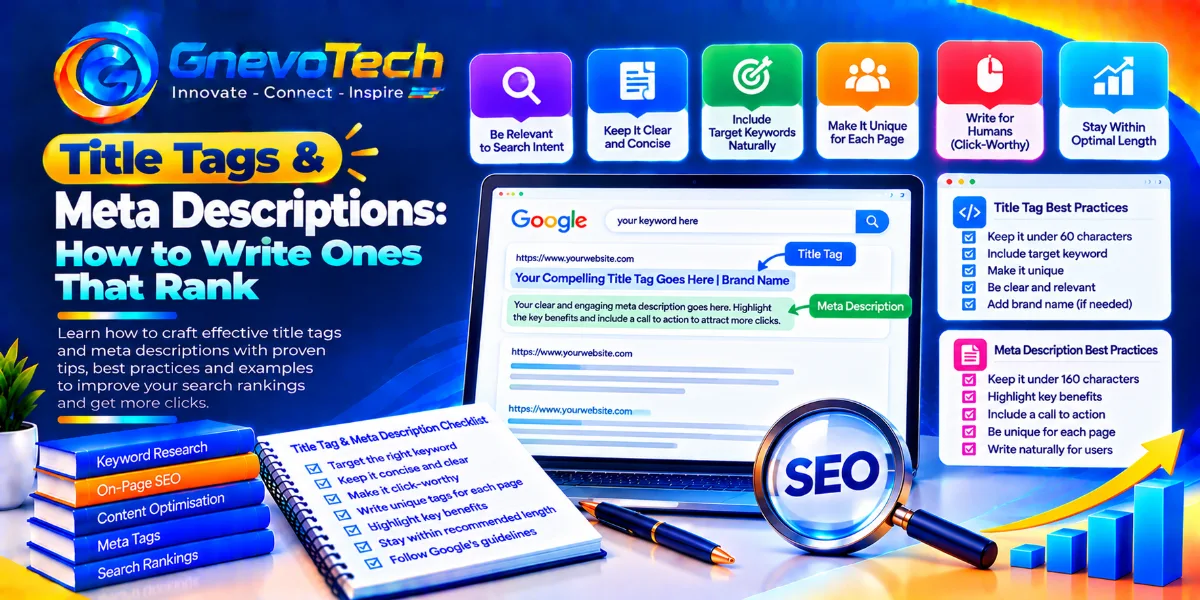
A title tag is the clickable headline in search results and the text on the browser tab. A meta description is the short summary under it.
Their jobs differ:
- The title tells search systems and people what the page is about
- The description gives a reason to click
Nobody can promise a ranking, and we won’t. Titles help a page be understood, but results also depend on competition, links and how searchers behave. Google changes how it shows these lines now and then, so check its official help pages before you act.
Start with the person searching
Before you type a single word, look at what already appears for your main phrase. Are the top pages guides, price lists, comparisons or local shops? That shows what searchers expect to find.
Then ask one plain question: what would make me choose this result over the ones next to it? A specific promise, a clear benefit or a local detail usually does it.
Writing the title tag
A good title is short, honest and specific.
- Put the main idea near the front, in plain words
- Add one detail that sets the page apart: a place, a year, a number or a benefit
- Keep it readable aloud, with no string of keywords
- Give every page its own title
- Finish with your brand name only if there’s room
Length matters because long titles get cut off in results. A common guide is around 50 to 60 characters, but it depends on the width of the letters, so treat it as a rough limit and check a preview.
Before and after
Real examples show the difference better than rules.
| Weak title | Stronger title | Why it works |
| Home | Custom Birthday Cakes in Jaipur | Says what and where |
| Services | Cake Delivery in C-Scheme and Vaishali Nagar | Names real areas |
| Blog Post 1 | How to Store a Fondant Cake Overnight | Answers a real question |
None of the stronger titles needed clever tricks. They just said what the page offered.
Where outside help fits in
Some owners can rewrite every title themselves. Others have hundreds of pages from an old site, or products that change weekly. For that kind of volume, many look into on-page SEO optimization, and a few questions keep the conversation honest.
- How will you decide which pages to rewrite first?
- Will you write by hand, or use templates for large sites?
- Who approves the final wording?
- How will you check what changed?
- What can’t you control?
A good provider shows examples and admits uncertainty. A weak one talks only about guarantees.

Writing the meta description
The description doesn’t directly decide rankings. Its job is to win the click, so write it like a short invitation.
- Describe what the page offers in one or two sentences
- Include the main idea in natural words
- Add a reason to act, such as a free quote, a price range or a delivery area
- Keep it to roughly 120 to 160 characters, as a rough guide
- Don’t copy the same text onto several pages
Google often rewrites descriptions to match what a person searched. That’s fine, and you shouldn’t take it as a sign you did something wrong. Write for people, and let the system choose.
Making local detail work for you
For businesses in Jaipur, local words help a result feel like it was made for the searcher. A neighbourhood, a landmark or a delivery area gives a quick signal that you’re nearby. Many customers also search in a mix of Hindi and English, so use the words your own buyers use.
If you run many pages across several branches, on-page SEO services in Jaipur can handle this clean-up at scale. Ask the provider to explain their method in writing and show similar work first.
Mistakes to catch in your own titles
- The same title on dozens of pages
- A list of keywords separated by pipes
- A promise the page can’t keep, such as “Best in India” with no proof
- A title so long it gets cut off mid-word
- A description copied from the first paragraph of the page
- Using capital letters for everything
Small habits like these quietly cost clicks. Reading each title aloud catches most of them.
What to do when Google rewrites your title
Sometimes the title that appears isn’t the one you wrote. Google says it may change titles that are too long, stuffed with keywords, vague or repeated across pages.
- Check whether your title is clear, specific and different from your other pages
- Make sure your main heading on the page says something similar
- Shorten it, and remove repeated words
- Wait a few weeks, since results update slowly
Rewrites aren’t punishments. They’re usually a hint that the original could be clearer.

Beware of big promises
You’ll see agencies calling themselves number one at everything. When you meet the phrase best on-page SEO agency in Jaipur, treat it as a reason to ask more questions, not as proof. Read real case studies, speak with a past client if you can and get terms in writing. Be careful with guaranteed rankings or quotes that don’t say what’s included.
Checking whether it worked
Titles and descriptions affect clicks, so measure clicks.
- Open your search performance report and look at impressions and click-through rate for the pages you changed
- Compare the weeks before and after, not single days
- Note which wording earned more clicks, and reuse the pattern
- Leave a change alone for a few weeks before trying another
A page can rank the same and still earn more visits with a better title. That’s a quiet win, and it counts.
A short routine to keep them fresh
You don’t need a big budget. Spend an hour on this each quarter:
- List your ten most important pages
- Read each title and description aloud
- Rewrite the weakest three
- Check that every page has its own wording
- Note the date, so you can compare results later
Then repeat with the next group of pages.
Conclusion: Say It Clearly, Then Let People Choose
A title tag and a meta description are the first words a stranger reads about your page. Make the title specific and honest, make the description an invitation and give every page its own wording. Check the results, keep the habit going and be wary of anyone who promises certainty in a field that keeps changing.
At Gnevotech, we help businesses say what they do clearly, so visibility grows from solid foundations and not from shortcuts.
Frequently Asked Questions
1. How long should a title tag be?
There’s no fixed limit, because display depends on letter width. Aiming for roughly 50 to 60 characters and checking a preview works for most pages.
2. Do meta descriptions affect rankings?
Not directly. They influence whether people click, which is why a clear, inviting description is still worth writing.
3. Why did Google change my title in search results?
It may rewrite titles that are too long, vague, stuffed with keywords or repeated across pages. Making yours clear and specific usually helps.
4. Should every page have a different title and description?
Yes. Unique wording helps people and search systems tell your pages apart, and avoids confusion between similar pages.