
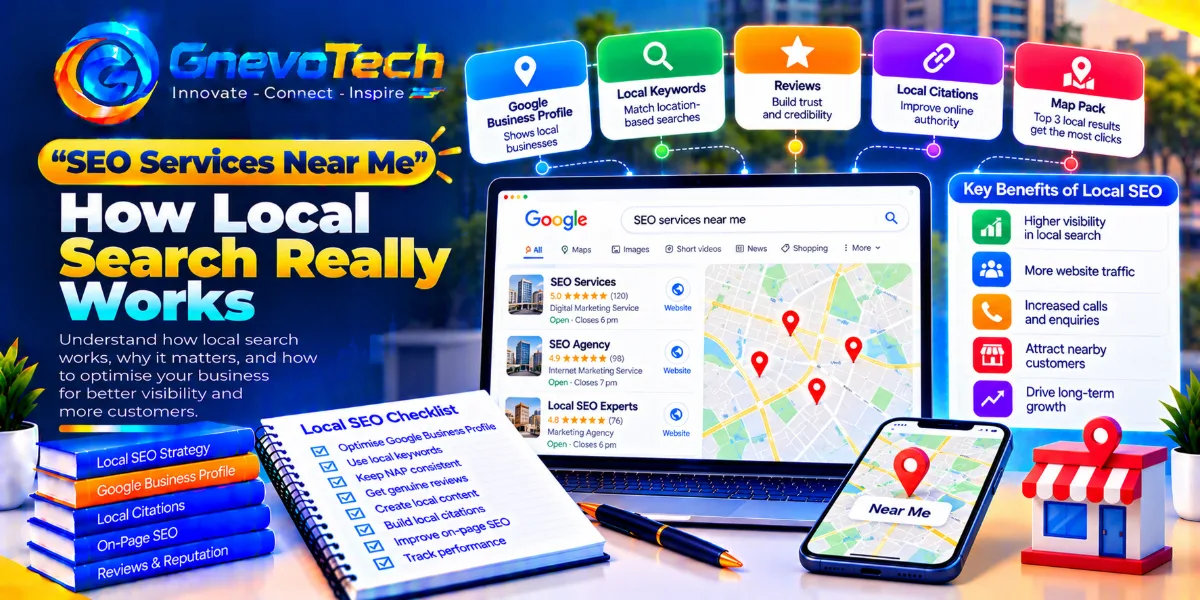
A tailor in Bapu Bazaar once asked us why a shop three streets away kept showing up when he searched “tailor near me” from his own doorstep. His reviews were better. His craftsmanship was better. But the other shop had a phone number that matched everywhere, a clear category and a map pin placed correctly. He had assumed “near me” meant whoever was closest. It doesn’t, quite. People who type that phrase and land on an SEO company in Jaipur are really asking how a search engine decides who deserves the top spot on the map.
Here’s how local search works, step by step.
What “near me” actually triggers
When someone types “near me”, the search engine does something different from an ordinary search. It checks the person’s location, then looks for businesses that fit the need and can be reached easily.
- The results often include a small map and a short list of businesses
- Organic web results appear below, and they’re ranked in a separate way
- The same search can show different results from two spots a kilometre apart
- Phrases without “near me”, like “tailor in Vaishali Nagar”, can trigger the same local results
So there isn’t one ranking for a phrase. There are many small rankings, one for each location.
The three ideas behind local results
Google describes local results as depending mainly on three factors:
- Relevance: how well your listing matches what the person searched for
- Distance: how close your business is to the searcher, or to the place named in the search
- Prominence: how well known and trusted your business appears, from reviews, mentions and your web presence
You can’t change distance. You can improve the other two, and that’s where nearly all the work sits.
Why a closer shop can still lose
Distance is one input, not the whole decision. A slightly farther business with a stronger profile can outrank a nearer one with a thin or messy listing. That’s why our tailor was puzzled. His shop was closer to his own doorstep, but its details were scattered across old directories, with two phone numbers and one outdated address.
Think of it as three questions the search engine asks quietly. Does this business match the need? Is it near enough? Do other people vouch for it?
Your business profile does most of the heavy lifting
For local searches, your Google Business Profile is usually the most important page you own. It’s free, and many owners leave it half-finished.
- Use your real business name, exactly as it appears on your signboard
- Choose a primary category that describes your main service, then add others only where true
- Keep your address, hours and phone number accurate, including festival timings
- Add real photos of your shop, team and work
- List your services and write a plain description
- Reply to every review, politely
Every blank field is a missed chance to match a search.
How owners often misread “strategy”
Local SEO work sometimes gets sold under big labels. Providers offering SEO strategy services can mean anything from a real plan to a recycled checklist. For a local business, a useful strategy answers a few plain questions:
- Which searches do your best customers type, and in which areas?
- What needs fixing first: profile, listings, website or reviews?
- Which pages should exist for each service and each area you serve?
- How will you tell whether it’s working?
If the plan can’t explain its first month in plain words, ask again.

Reviews: the quiet engine of prominence
Reviews do two jobs. They help people decide, and they help the search engine judge how well known you are.
- Ask satisfied customers at the moment they’re happiest, with a simple link or QR code
- Make it easy, because every extra step loses people
- Reply to every review, including critical ones, calmly and specifically
- Never buy reviews, offer rewards for them or write your own
Google can remove fake or incentivized reviews, and a suspended profile costs far more than any shortcut ever gains.
Consistency across the web
Your business name, address and phone number should match everywhere: your profile, website, social pages and directories. Small differences, such as “Rd” in one place and “Road” in another, can create confusion over time.
- Decide on one correct version of each detail
- Update old listings, or remove them if they can’t be fixed
- Add the business to respected local and industry directories
- Review everything every few months
It’s dull work, and it’s one of the cheapest ways to build trust.
What your website adds
Your website supports your profile, and your profile points to it. A site that mentions your area, lists your services clearly and loads quickly gives search engines more to work with.
- Create a clear page for each main service
- Mention the neighborhoods you serve, naturally, without stuffing
- Put your address, phone number and a map on your contact page
- Keep the same name and details as your profile
- Make sure the site is fast and easy to use on a phone
If a sentence sounds odd read aloud, the place name was probably forced. Rewrite it.
Local language, local habits
People in Jaipur search in a mix of Hindi and English, and they name colonies, markets and landmarks more often than postcodes. “Cooler repair near Raja Park” and “shaadi photographer Jaipur” are typed exactly like that. Use the words your own customers use, in your service descriptions, replies and web pages.
Owners comparing an SEO agency in Jaipur for this kind of work should ask how the provider learns those local phrases. A good answer involves real customer questions, not just a keyword tool.
Common myths about “near me”
Some beliefs cost owners money.
- “I can pay to be at the top of the map.” Google says local ranking can’t be bought. Paid ads are separate and labelled
- “More keywords in my business name will help.” It breaks Google’s guidelines and can lead to suspension
- “A virtual address will make me look closer.” It can get a profile suspended
- “Rankings are the same for everyone.” They vary from one location to the next
- “I fixed it once, so I’m done.” Details drift, and competitors keep improving
Steady, honest work protects what you build.

How to check where you really stand
A single search from your own shop proves very little, because rankings change by location.
- Look at your profile’s insights for searches, calls and direction requests
- Check results from a few nearby areas, or use a rank-tracking tool
- Count real calls and inquiries, not only views
- Keep notes on what you changed and when
- Compare month to month, not day to day
Give changes a few weeks before judging. Local results move, but rarely overnight.
Making sense of the word “best”
Every provider seems to claim the top spot. When you see the phrase best SEO company in Jaipur, treat it as a cue to ask for evidence, not as proof. Look for case studies you can read, references you can call and terms in writing. Be wary of anyone who guarantees a map position, a number of calls or a date, because those depend on competition, location and how people search. Google also updates its guidance now and then, so check its official help pages before acting on any advice.
Conclusion: Local Search Rewards Clear, Honest Businesses
“Near me” searches don’t simply favor the closest shop. They favor the one that matches the need, sits within reach and looks well known and trustworthy. Complete your profile, keep your details consistent, earn honest reviews, build a clear website and use the language your customers actually use. And be wary of anyone who promises certainty in a field that keeps changing.
At Gnevotech, we help local businesses become easier to find and easier to trust, so visibility grows from solid foundations and not from shortcuts.
Frequently Asked Questions
1. Why does a farther business sometimes rank above a closer one?
Distance is only one factor. Relevance and prominence also count, so a business with a complete profile, consistent details and strong reviews can outrank a nearer one with a weak listing.
2. Can I pay to rank higher in “near me” results?
Google says local organic ranking can’t be bought. Paid ads are separate and are labelled as ads. Map position comes from relevance, distance and prominence.
3. Do I need a website for local search?
It isn’t always required, but a clear website that mentions your services and area supports your profile and gives customers more to trust.
4. How long does it take to improve local rankings?
It varies with competition, location and how complete your profile is. Give changes a few weeks, then track progress month by month.