
A homestay owner near Amer Road told us he’d hired three freelancers in one year. The first rewrote his pages, the second bought links and the third made the site faster. Nobody told him which job was which, and none of them knew what the others had done. His rankings stayed put and his bills didn’t. He wasn’t unlucky. He just lacked a simple map. Plenty of owners begin by searching for on-page SEO services and only later learn that it’s one of three separate jobs.
Here’s the map we give people, in plain words.
Why the labels confuse so many people
Agencies, tools and blogs don’t always draw the lines in the same place. A task that one team calls technical, another files under on-page. That’s why two proposals can look completely different while describing similar work.
- The three names describe where the work happens, not how important it is
- Some tasks sit between two groups, such as structured data or internal links
- A good plan matters more than which box a task goes in
Hold the labels loosely, and look at what is actually being changed.
A restaurant makes it easy to see
Picture a restaurant that wants more diners.
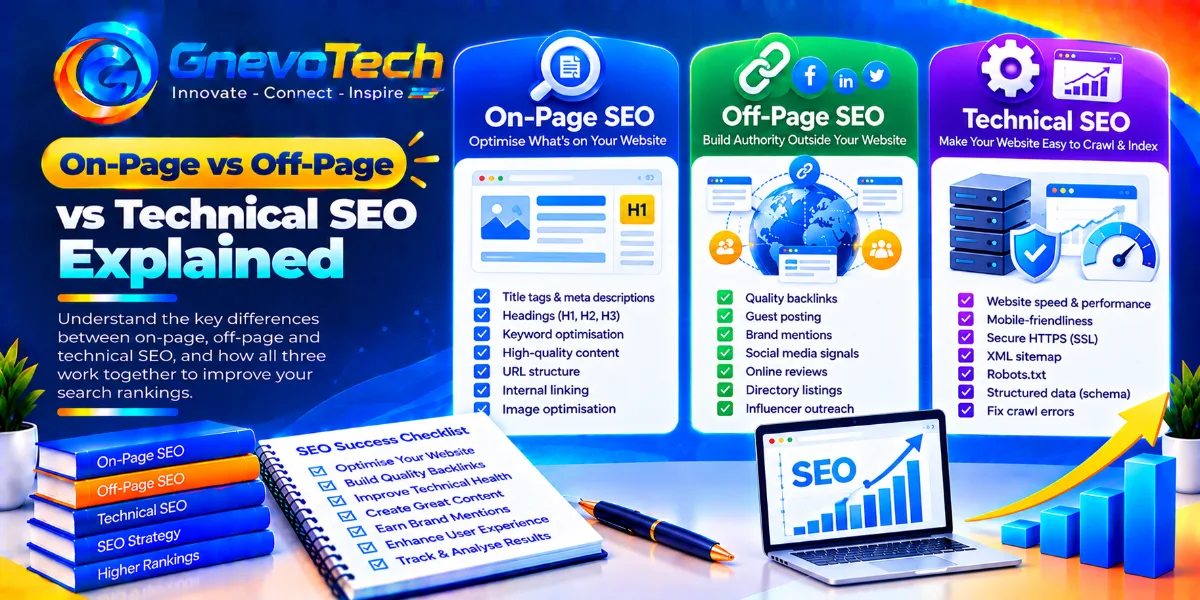
- Technical SEO is the building. Doors that open, working lights, a clear entrance and a kitchen that doesn’t flood
- On-page SEO is the menu and the dishes. What you serve, how it’s described and whether a hungry person can find what they want
- Off-page SEO is the reputation. What neighbours, critics and regular customers say about you elsewhere
A beautiful menu is useless if the door is locked. A perfect building won’t help if the menu is confusing. And a strong reputation can’t rescue an empty kitchen. All three have to work.
Technical SEO: the building
This is the work that lets search systems reach, read and understand your site. Visitors rarely notice it when it’s right and notice it immediately when it’s wrong.
- Pages that can be crawled and indexed
- Fast loading, especially on a phone
- A secure connection and a tidy site structure
- A sitemap, sensible redirects and no broken links
- Clean handling of duplicate or near-identical pages
Typical signs of trouble: pages that never appear in search, a site that crawls on mobile, or error messages after a redesign. Technical problems are often invisible until someone looks, so a periodic check pays for itself.
On-page SEO: the menu and the dishes
This covers everything on the page that you can edit directly. It’s the part owners can usually do themselves, and it’s where changes tend to show first.
- Titles, descriptions and headings that say what the page offers
- Content that answers the real question, with experience in it
- Labelled images and readable layouts
- Sensible internal links between related pages
- Keywords used like signposts, not seasoning
Teams that call this work on-page SEO optimization are usually talking about a page-by-page review: what each page is for, whether it matches what searchers want and what’s missing. It’s detailed, steady work, and rarely dramatic.
Off-page SEO: what people say about you
This is everything that happens beyond your own site and still shapes how trusted you look.
- Links and mentions from relevant, reputable websites
- Genuine reviews on well-known platforms
- Listings and directory entries with matching details
- Press, partnerships and community involvement
- People searching for your brand by name
An honest limit: you can’t fully control this side, and shortcuts like bought links or fake reviews can do real harm. It grows from being worth mentioning, which takes time.
The three side by side
| Point | Technical | On-page | Off-page |
| Where it happens | Behind the scenes of your site | On your pages | On other sites and platforms |
| Main question | Can search systems reach and read us? | Does each page answer the need? | Do others vouch for us? |
| Who usually does it | Developer or specialist | Writer, marketer or owner | Outreach, PR or the owner |
| How fast it shows | Often quick once fixed | Weeks to months | Months |
| Biggest risk | Breaking things during changes | Thin or copied content | Spammy shortcuts |
Treat this table as a guide. Real projects blur the edges.

Which one to fix first
You don’t need to fix all three at once. A sensible order exists.
- Check the building. If important pages can’t be found or load painfully slowly, nothing else will land
- Then work on the menu. Make your key pages clear, specific and helpful
- Then build the reputation. Earn reviews, mentions and links once there’s something worth pointing to
Skipping step one is a common and expensive mistake. Chasing links to a page that can’t be indexed is like advertising a shop that’s shut.
What this looks like for Jaipur businesses
Local owners often start with page fixes because the effect is visible quickly and the cost is modest. A hotel, a coaching center, or a clinic usually has a handful of pages that matter most, and each needs a clear title, an honest description and local detail such as neighborhoods, landmarks and the way customers phrase searches, often mixing Hindi and English.
Some owners start with an on-page SEO agency in Jaipur for exactly this reason, then add technical checks and local mentions as they go. Whoever you choose, ask which of the three jobs each task belongs to. If they can’t say, the plan may not be clear.
Where the three overlap
Real sites don’t separate neatly. A few examples show why.
- Page speed is technical, yet it’s affected by the size of the images you upload
- Internal links are on-page, but they only work if the site structure is sound
- Reviews live off-site, and many businesses also show them on their own pages
- Structured data helps search systems read a page and sits between technical and on-page
Seeing the overlap keeps you from assigning a problem to the wrong person.
How to read an SEO report without feeling lost
Reports can be long and full of charts. A simpler approach is to sort each line into the three groups.
- For every task listed, write T, P or O beside it
- Count how many fall into each group, and note anything missing
- Ask what changed on the site in plain words
- Look for results that connect to the work, such as inquiries, not just visits
- Ask what happens next month
If a report is all one group, such as nothing but links, ask why. A balanced plan usually touches all three over time.

Choosing help without confusion
Many businesses reach a point where they lack the time or the skills for one or more of the three. If you’re comparing on-page SEO services in Jaipur, a few plain questions keep the conversation honest.
- What exactly will you change on our pages, and what will you leave alone?
- How do you decide which pages come first?
- Who writes the changes, and who approves them?
- How do you handle the technical and off-site parts?
- What will we receive each month, in plain terms?
- What can’t you control?
A good provider answers calmly and admits uncertainty. A weak one leans on jargon and guarantees. Nobody can promise a ranking, and we won’t. Results depend on competition, your site’s history, links and how searchers behave. Google also updates its guidance now and then, so check its official help pages before you act.
A five-minute self-check
Before you spend money, try this on your own site.
- Search your business name. Does your site appear, and does it look right?
- Open your main page on a phone. Is it quick, and can you tap everything?
- Read your page titles. Does each say something specific?
- Search for your service plus your area. Who appears, and why?
- Look at your reviews and listings. Do the details match?
Your answers will usually point to the group that needs attention first.
Conclusion: Know the Job Before You Hire for It
Technical SEO keeps the doors open, on-page SEO makes the menu clear and off-page SEO builds the reputation. Fix them in that order, expecting each to move at a different speed and keep an eye on where they overlap. Ask anyone who offers help to explain which job they’re doing, and be wary of those who promise certainty in a field that keeps changing.
At Gnevotech, we help businesses understand which kind of SEO they need first, so visibility grows from solid foundations and not from shortcuts.
Frequently Asked Questions
1. What is the difference between on-page and off-page SEO?
On-page work happens on your own pages, such as titles, content, images and internal links. Off-page work happens elsewhere, such as links, mentions and reviews that show others trust you.
2. Where does technical SEO fit in?
It’s the foundation. It covers crawling, speed, mobile use and site structure, so search systems can reach and understand your pages in the first place.
3. Which should I work on first?
Check the technical basics, then improve your key pages, then build a reputation. Skipping the first step can waste effort on the other two.
4. Can I do all three myself?
Many basics can be handled in-house, especially page improvements. Technical and outreach work can need specialist help, depending on your site and your time.