
A physiotherapist in Jaipur once sent us a list of twelve guest posts she had “placed” in a month. Everyone sat on a site that accepted anything, from tire reviews to tax advice, and everyone carried the same keyword-packed link back to her clinic. Her rankings didn’t move. Two of the posts were later taken down. She had treated guest posting as a link-delivery service when it worked better as an introduction to a new audience. Many owners in her position start asking about off-page SEO services, but the real skill is choosing where to write and what to say.
Here’s how we’d do it properly, one step at a time.
The short version, and one honest note
If you only have a minute:
- A guest post is an article you write for another site to reach its readers
- Pick sites your customers actually read, not sites that accept everyone
- Write something you’d be proud to publish on your own blog
- Keep the author bio and links natural, and label paid placements honestly
- Measure readers and inquiries, not only links
- Quality beats volume every time
The honest note: nobody can promise a ranking, and we won’t. Google has said that large-scale guest posting done mainly to pass links can break its spam policies, so check its official guidance before you start. Used as real outreach, guest posting is still a sensible way to build a reputation.
What guest posting actually is
You write a useful article for a website that isn’t yours. The site gets fresh content its readers value. You get exposure, a credited author bio and sometimes a link. Done well, both sides benefit and readers learn something.
Done badly, it turns into mass-produced articles with a paid link, written for search engines instead of people. That version is the one that gets sites into trouble.
Why it can still be worth your time
The honest benefits are mostly about people, not rankings.
- Reach: you meet an audience that doesn’t know you yet
- Credibility: appearing on a respected site tells readers you know your subject
- Relationships: editors, writers and fellow experts remember a good contributor
- Referral visits: a strong article can send real, interested visitors
- Mentions: other writers may cite a useful piece later
A link may come along with these, but it shouldn’t be the only reason to write.
Step 1: Decide what you want and who you want to reach
Before looking for sites, answer three questions on paper.
- Who is the reader we want to meet?
- What do we want them to do after reading, such as visit a page or subscribe?
- What do we know well enough to teach them?
If you can’t answer these, any guest post will drift. A clear reader and a clear topic make every later choice easier.
Step 2: Find sites that are worth writing for
Look for places where your ideal customer already spends time.
- Blogs and magazines in your industry
- Local publications and community sites
- Partner, supplier and association websites
- Podcasts and newsletters that take written contributions
- Colleges and training bodies that run knowledge hubs
Check each one before you pitch. Does it have real readers, regular posts and original content? Does it cover a topic close to yours? Would you be happy to be seen there?
When a specialist helps

Plenty of this can be done in-house. Others lack the contacts, the time or the writing capacity to run outreach properly. If you’re comparing an off-page SEO agency in Jaipur, a few plain questions keep the conversation honest.
- Can you show real articles you’ve placed for businesses like mine, with context?
- How do you choose and approve the sites you pitch?
- Do you ever pay for placements, and how are they labelled?
- Who writes the articles, and who edits them?
- What can’t you control?
A good provider answers calmly and admits uncertainty. A weak one leans on counts and guarantees.
Step 3: Pitch like a person
Editors receive dozens of generic emails a week. A short, specific message stands out.
- Read recent posts and mention one by name
- Suggest two or three specific topics, with a line on why their readers would care
- Say briefly why you’re qualified to write them
- Link to one or two samples of your writing
- Keep it short, polite and easy to answer
- Follow up once, then move on
Don’t send the same message to a hundred sites. Ten careful pitches usually beat a hundred copied ones.
Step 4: Write the article properly
Treat a guest post as a gift to the host site’s readers.
- Choose a topic the site’s audience genuinely needs help with
- Lead with the answer, then explain
- Use real examples from your work, with private details removed
- Match the host’s style and format
- Mention your business only where it genuinely helps the reader
- Edit it as carefully as you would your own flagship page
An honest limit: a thin, generic article won’t help you, even on a good site. Editors can tell, and so can readers.
Step 5: Handle links and bios naturally
Links should help the reader, not decorate your ranking plans.
- Use your author bio for a short, honest line about who you are
- Link to a page that’s genuinely useful to someone who just read the article
- Use natural anchor text, such as your brand or a plain description
- Avoid repeating the same keyword-heavy anchor in every post
- If a placement is paid or sponsored, label it as the platform and Google’s guidance suggests
If a link wouldn’t make sense without search engines in the picture, rethink it.
Using your Jaipur advantage
Local relevance helps a lot. A mention in a Jaipur business magazine, a trade association blog or a college knowledge page tells readers you’re a real business in a real place. Writing about local topics, such as seasonal demand, regional buying habits or city-specific rules, makes articles more useful to local editors.
Businesses that want help finding the right local and industry outlets sometimes look at off-page SEO services in Jaipur. Ask the provider to explain their method in writing and show similar work first.
Red flags when you’re offered “guest post packages”
Some offers are better avoided.
- A fixed price per post on sites that accept anything
- Promises of a set number of links each month
- Sites that publish on every topic, from casinos to cooking
- Articles written by someone with no knowledge of your business
- Anchor text chosen entirely for keywords
- Reluctance to show you the sites in advance
If you wouldn’t be comfortable explaining the placement to a customer, skip it.

How to measure whether it worked
Counting posts tells you little. Look at several things together.
- Visits that came from the article, in your analytics
- Enquiries, sign-ups, or sales that followed
- Branded searches, since readers often look up a name they just met
- New mentions or invitations from other editors
- Whether the linked page gained any movement in search over time
Give an article a few months before judging. Some of the benefit arrives slowly.
Claims worth treating with care
You’ll see plenty of agencies calling themselves number one. When you come across the best off-page SEO agency in Jaipur, treat the phrase as a reason to ask more questions, not as proof. Read real case studies, speak with a past client if you can and get terms in writing. Be careful with guaranteed rankings, a fixed number of posts per month or quotes that don’t say what’s included.
Mistakes we see all the time
- Writing for any site that says yes
- Stuffing the article with promotion
- Sending identical pitches to hundreds of editors
- Using the same exact anchor text every time
- Publishing thin articles that say nothing new
- Never checking whether anyone read the post
- Expecting results within a few weeks
Most of these come from impatience. Steady, honest outreach tends to win.
A thirty-day starting plan
You don’t need a big budget to begin.
- Week one: Define your reader, your goal and three topics you can teach well
- Week two: List fifteen relevant sites and read what each one publishes
- Week three: Send five personal pitches, and draft one strong article while you wait
- Week four: Publish or submit, track the results and note what you’d improve
Then repeat the cycle, keeping what works and dropping what doesn’t.
Conclusion: Write to Be Read, and the Rest Follows
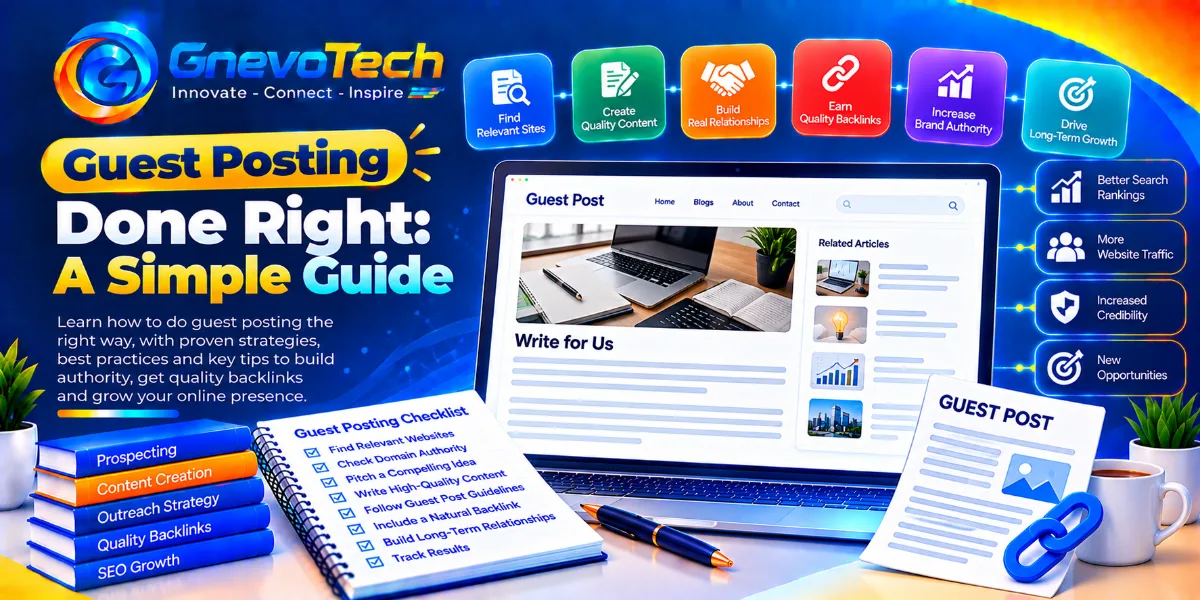
Guest posting works when it serves readers first: the right site, a useful article, a natural bio and honest labels. Treat links as a by-product, quality as more important than volume and anyone promising certainty with caution.
At Gnevotech, we help businesses earn visibility the honest way, so reputation grows from solid foundations and not from shortcuts.
Frequently Asked Questions
1. What is guest posting?
It’s writing an article for another website so its readers learn from you. You usually get a credited bio and sometimes a link, while the host site gets useful content.
2. Is guest posting still allowed by Google?
Writing for other sites is fine. Google has said that large-scale guest posting done mainly to pass links can break its spam policies, so focus on real value and label paid links properly.
3. How many guest posts should I publish?
There’s no right number. A few well-placed, carefully written articles usually do more than many weak ones, and it depends on your goals and competition.
4. How do I know a site is worth writing for?
Check that it has real readers, regular original content and a topic close to yours. If you wouldn’t be comfortable being seen there, skip it.