
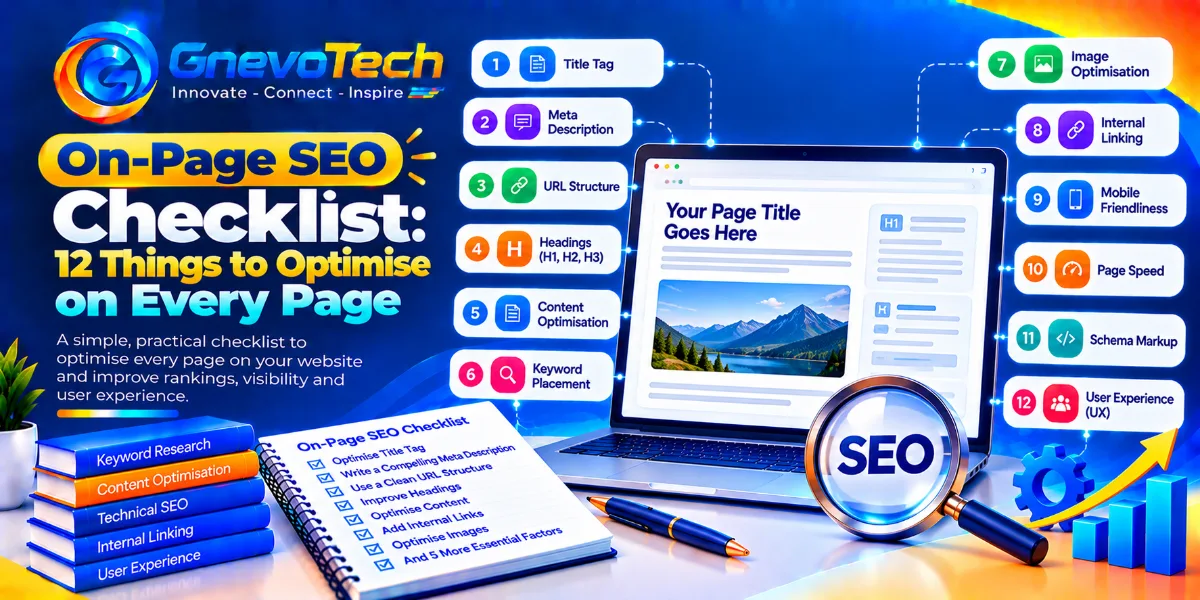
A caterer in Jaipur once showed us her homepage and asked why it never appeared for “wedding catering." The page looked lovely. The title tab said "Home." The main heading said "Welcome." The photos were named IMG_4471 and IMG_4472. Nothing on the page told a search system, or a stranger in a hurry, what she actually did. She had built a beautiful page and left off every label. Many owners start looking at on-page SEO services after a moment like this, but most of what follows can be done in an afternoon with a notepad.
How to use this checklist
Work through the twelve points in order, one page at a time. Start with your most important page, usually the one that earns you inquiries, then move to the next.
A fair warning before we begin. Nobody can promise a ranking, and we won’t. These steps earn a page a fair chance, but results also depend on competition, links and how searchers behave. Google updates its guidance now and then, so check its official help pages before you act.
1. Give the page one purpose
A page that tries to rank for five things usually ranks for none. Write one sentence: “This page helps [who] to [do what].”
If you can’t finish that sentence, the page isn’t ready to be optimized. Split it, merge it or rewrite the plan first.
2. Match what the searcher wants
Look at what already appears for your main phrase. Are the top results guides, product lists, comparisons or local businesses? That shows what searchers expect.
- Learning: give a clear explanation
- Comparing: give a side-by-side view
- Doing: give steps
- Buying or hiring: give options, prices where possible and proof of trust
Match the format first, then do it more clearly and more honestly than what’s there.
3. Write a title that earns the click
The title shows on the browser tab and in search results. It’s often the first thing a person reads, and it’s the quickest piece of on-page SEO optimization you can do, because it costs nothing and takes minutes.
- Put the main idea near the front, in plain words
- Make it specific, not just “Home” or "Services."
- Keep it readable, without a string of keywords
- Give every page a different title
A good title promises exactly what the page delivers.
4. Write a meta description people want to read
The short summary under the title doesn’t directly decide rankings, but it influences whether people click.
- Describe what the page offers in one or two sentences
- Include the main idea naturally
- Add a reason to click, such as a free checklist or a local detail
- Don’t copy the same description onto several pages
Google sometimes rewrites descriptions, so don’t worry if yours changes. Write it for people first.
5. Use one main heading, then clear subheadings
Each page needs one main heading that says what it’s about. Subheadings then break the content into sections a skimming reader can follow.
- Write headings as phrases or questions a person would really use
- Keep the order logical, from the big idea to the details
- Don’t use headings only to make text bigger
If someone read only your headings, would they understand the page? That’s the test.

6. Put the direct answer near the top
Visitors decide in seconds whether a page helps. Give the answer, or a clear summary, in the first few lines, then add detail below.
It also makes the page easier for search systems and AI tools to read and, sometimes, to quote. Of all the habits here, this one pays off the most.
Adding local detail if you’re in Jaipur
If your customers are in one city, say so, and show it in the details: neighborhoods, landmarks, local examples and the way people phrase searches, often mixing Hindi and English. Put your address, phone number and a map on your contact page, and make sure they match your Google Business Profile.
Owners with many pages sometimes look at on-page SEO services in Jaipur for this kind of clean-up. Ask the provider to explain the scope in writing and show similar work first.
7. Show real experience
Generic pages are everywhere. What stands out is proof that someone with real knowledge wrote this one.
- Name the author and say why they’re qualified
- Use examples from actual work, with private details removed
- Share a mistake and what it taught you
- Be upfront about limits, such as “this works for small sites, not large ones”
- Update facts when they change
Experience is hard to fake for long. Readers notice when someone describes work from a distance.
8. Use keywords like signposts
Keywords still matter, but they work as signposts, not seasoning. Use the main phrase where it fits: the title, one heading, the opening lines and a few spots in the body. Add related words too, because people ask the same thing in different ways.
If a sentence sounds odd read aloud, the keyword is probably forced. Rewrite the sentence.
9. Label your images
Images help readers and can bring visitors from image search, but only if they’re labelled.
- Rename files to say what they show, such as “wedding-thali-jaipur.jpg”
- Write alt text that describes the image in a plain sentence
- Compress images so pages load quickly, without making them blurry
- Don’t stuff alt text with keywords
Alt text also helps people who use screen readers, which is reason enough to do it well.
Choosing outside help without falling for big names
Some owners can run through all twelve points alone. Others have hundreds of pages or a team that edits content without a plan. If you hire help, ask:
- What exactly will you change on our pages, and what will you leave alone?
- How do you decide which pages come first?
- Who writes, and who approves the changes?
- What will we receive each month, in plain terms?
- What can’t you control?
You’ll also see agencies calling themselves number one. When you meet the phrase "best on-page SEO agency in Jaipur", treat it as a reason to ask more questions, not as proof. Read real case studies, speak with a past client if you can and get terms in writing. Be careful with guaranteed rankings or quotes that don’t say what’s included.

10. Link your pages together sensibly
Internal links help visitors find related content and help search systems see how your pages connect.
- Link from important pages to relevant ones, using descriptive words
- Avoid vague link text such as “click here."
- Link new pages from older ones that already get visits
- Check for broken links regularly
Every page should be reachable within a few clicks. A page with no links pointing to it is easy to miss.
11. Make the page quick on a phone
Most visitors browse on a phone, often on a patchy connection.
- Compress images and remove scripts you don’t truly need
- Keep text readable and buttons large enough to tap
- Avoid pop-ups that cover the content
- Check the page on a real phone, not only on a desktop
Forget the speed scores for a moment. If your own family finds the page annoying on a phone, a stranger will too.
12. Add structured data where it fits
Structured data is a standard way of labelling what’s on a page, so search systems can read details accurately. Depending on the page, that might be your business details, a product, an article or frequently asked questions.
Make sure what you mark up matches what’s visible. It helps pages be understood, though it doesn’t guarantee any special display in results.
A five-minute review for each page
After the twelve points, ask:
- Does the page have one clear purpose?
- Does the title say what the page offers?
- Is the answer visible in the first few lines?
- Do the headings tell the story on their own?
- Are images labelled, and is the page quick on a phone?
Give changes a few weeks before judging. Search systems need time to notice updates.
Where owners usually slip
- Giving every page the same title and description
- Stuffing keywords into headings and alt text
- Hiding the answer under a long introduction
- Forgetting to link new pages from existing ones
- Optimizing once and never looking again
- Copying a competitor’s page and calling it done
- Expecting results within a few weeks
Most of these come from impatience. Steady improvement wins.
Conclusion: Clear Labels, Clear Pages
On-page SEO is the habit of making every page clear to people first and to search systems second. Give each page one purpose, a specific title, a direct answer, real experience, labelled images and sensible links. Keep it fast, keep it accurate and review it regularly. Be wary of anyone who promises certainty in a field that keeps changing.
At Gnevotech, we help businesses make their pages clearer and easier to trust, so visibility grows from solid foundations and not from shortcuts.
Frequently Asked Questions
1. What is on-page SEO?
It’s the work of improving the parts of a page you control, such as the title, headings, content, images, internal links and speed, so people and search systems can understand it.
2. How many keywords should I use on a page?
There’s no magic number. Use the main phrase where it reads naturally, add related words and rewrite any sentence that sounds forced.
3. How often should I review my pages?
Every few months is sensible for key pages, and straight after major changes. Facts, competitors and search behaviour all shift over time.
4. How long do changes take to show results?
It varies with competition and your site’s strength. Give changes a few weeks to be noticed, then keep improving based on what you see.