
A marketing head at a Jaipur furniture brand told us she’d sat through two vendor pitches in one week. The first called the work “LLM optimization.” The second called it “GEO.” Both promised to get her brand named in AI answers, and both used the same slides. She asked us a fair question: “Are these two different jobs, or one job with two names?” Brands in her position often start comparing AI search optimization services, and the honest answer is simpler than the pitch decks suggest.
Here’s how we’d untangle it, one point at a time.
The short version, and one honest note
If you only have a minute:
- LLM optimization and GEO overlap heavily, and many people use the terms interchangeably
- LLM optimization usually focuses on the models behind AI tools: how they understand and mention your brand
- GEO, generative engine optimization, usually focuses on the answers those tools show to users
- Both rest on the same foundations: clear content, consistent facts, real expertise and honest mentions elsewhere
- Neither can be guaranteed
The honest note: these terms are young, and there’s no official definition that everyone follows. Agencies draw the lines in different places. Treat any firm claim about where one ends and the other begins with a little caution, and focus on the work being proposed, not the label.
What each term usually means
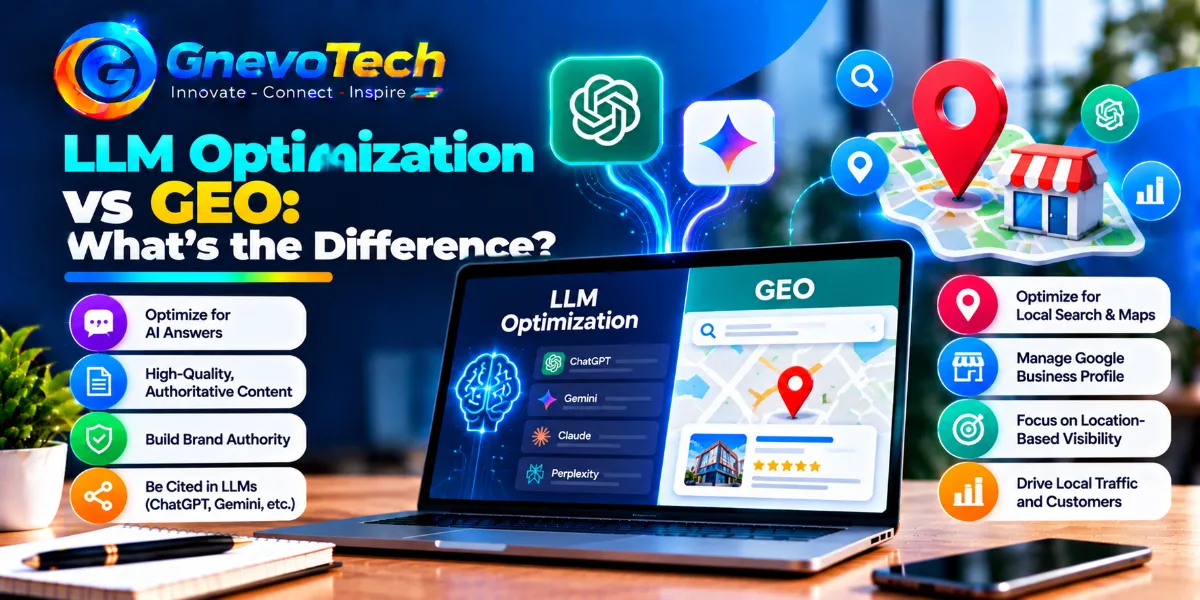
LLM optimization is about making your brand and content easy for large language models to understand, trust and mention. The word “LLM” points at the technology: the model that reads, learns and writes.
GEO, or generative engine optimization, is about appearing well in the answers that generative tools produce. The word “engine” points at the experience: a person asks a question and gets a written reply that names a few options.
One looks at the machine. The other looks at the result in front of the user. In practice, you can’t do one without touching the other.
How they overlap
Most of the real work is shared.
- Write clear, direct answers to real customer questions
- Keep your name, address, services and hours consistent everywhere
- Show real experience, with named authors and honest examples
- Earn reviews and mentions on other trusted sites
- Keep pages fast, readable and easy to crawl
If a provider describes a plan that doesn’t include these, ask why. If it does, the choice of label matters much less.
Where the emphasis can differ
Some differences are genuine, even if the edges are blurry.
| Point | LLM optimization | GEO |
| Main focus | How models understand and mention your brand | How your brand appears in generated answers |
| Typical thinking | Brand reputation across the web, long-term | Answer formats, citations and visibility per question |
| What gets checked | Whether tools describe you accurately | Whether and how you appear for specific queries |
| Time horizon | Slower, built over months | Can show earlier signals but also shifts quickly |
Treat the table as a rough guide, not a rulebook. Different agencies mix these differently.
Where traditional SEO fits in
Neither term replaces search optimisation. A page that loads quickly, can be crawled and is well structured serves people, search engines and AI tools alike. Some teams offering LLM SEO services treat all of this as one joined-up job, which is a sensible way to see it. You build on what already works and add habits that make your brand easier to understand.

Why the label matters less than the plan
Two vendors can use different words and do the same work, or use the same word and do very different work. So when you hear a pitch, set the jargon aside and ask what will actually change.
- What will you change on our site, and what will you create?
- How will you check whether AI tools mention us, and how often?
- How do you handle the fact that these tools keep changing?
- What will we receive each month, in plain terms?
- What can’t you control?
A good provider answers calmly and admits what’s uncertain. A weak one leans on jargon and promises.
A closer look at the shared foundations
Since the work overlaps so much, it helps to see each piece clearly.
Clear answers. Put a short, direct answer near the top of each page, then add detail. Write headings as the questions customers really ask.
Consistent facts. Tools find it harder to trust a business whose details differ across its website, listings and social profiles. Pick one correct version and update everything to match.
Real expertise. Name your authors, use examples from actual work and be upfront about limits. Generic content is easy to find. Proof of experience is not.
Honest mentions. Genuine reviews, industry features and respected directories show that others vouch for you. Never buy fake reviews or bulk links.
How to measure either one
Measurement is the awkward part, whatever you call the work. AI answers vary by wording, by user and even by day, so one test proves very little.
- Write a list of twenty questions your customers really ask
- Ask them in a few different AI tools, in plain wording
- Note whether your brand is named, linked or described correctly
- Repeat monthly, and look for patterns instead of single results
- Watch branded searches and inquiries, since people often look up a name they saw in an answer
Treat these as signals, not proof. A trend across several months tells you far more than one screenshot.
A local angle for Jaipur businesses
Many questions to AI tools include a place: a clinic in Malviya Nagar, a coaching class near Mansarovar, or a showroom in Sitapura. If you serve a local area, say so plainly on your pages and keep your business profile accurate. Think about how your buyers phrase questions, which often mixes Hindi and English.
Brands that want specialist help with this detail sometimes look at LLM optimization services in Jaipur. Ask the provider to show relevant work and explain the scope in writing before you agree to anything.
Choosing between the two
You don’t really have to choose. What you need to decide is whether you want help, and what kind.
- Do it yourself first if your budget is tight. Fix inconsistent details, answer real questions clearly and collect honest reviews
- Get help with specific pieces if you lack time or skills, such as structure, content or tracking
- Bring in a full-service partner if you want planning, execution and reporting handled together
Whatever you pick, ask for the plan in writing, and judge it by what will change, not by which acronym is on the proposal.

Mistakes we see all the time
- Paying more because a service uses the newer-sounding name
- Treating either one as a replacement for SEO instead of an extension
- Stuffing pages with phrases written for machines
- Letting business details drift between websites and listings
- Chasing every new tool before the basics are right
- Paying for guarantees that nobody can honestly give
- Expecting results within a few weeks
Most come from impatience. Steady work tends to win.
Claims worth treating with care
You’ll see plenty of agencies call themselves number one. When you come across the best LLM optimization agency in Jaipur, treat the phrase as a reason to ask more questions, not as proof. Read real case studies, speak with a past client if you can and get terms in writing. Be careful with guaranteed mentions, instant results or quotes that don’t say what’s included.
A thirty-day starting plan
You don’t need a big budget to begin.
- Week one: Audit your website and listings, and fix inconsistent business details
- Week two: Write down twenty real customer questions and check how your pages answer them
- Week three: Rewrite your five most important pages with a direct answer, a real example and clearer structure
- Week four: Ask for a few honest reviews, and check how your brand appears in a handful of AI answers
Then repeat the cycle each month.
Conclusion: Judge the Work, Not the Label
LLM optimization and GEO are close relatives, and the line between them depends on who you ask. What matters is the work underneath: clear answers, consistent facts, real expertise and honest mentions from others. Build on strong SEO, measure patterns over time and be wary of anyone who promises certainty in a field that keeps changing.
At Gnevotech, we help brands become clearer and more trustworthy across search and AI answers, so visibility grows from solid foundations and not from shortcuts.
Frequently Asked Questions
1. Are LLM optimization and GEO the same thing?
They overlap heavily, and many people use the terms interchangeably. LLM optimization leans toward how models understand your brand, while GEO leans toward how you appear in generated answers.
2. Do I need both?
Usually the same groundwork covers both: clear content, consistent facts, real expertise and honest mentions. Focus on the work being done, not the name attached to it.
3. Can anyone guarantee a mention in an AI answer?
No. These tools differ and change often. A trustworthy provider explains what they can influence and is honest about what they can’t.
4. Where should a small business start?
Fix inconsistent business details, answer customers’ real questions clearly on key pages, collect genuine reviews and check regularly how your brand appears.