A growing number of customers never scroll a results page anymore. They ask ChatGPT, Perplexity, or Google’s AI Overview a question and act on whatever answer comes back. If a business is not part of that answer, it simply does not exist to that customer at that moment. This is the reality Answer Engine Optimization was built to address, and at Gnevotech, it is one of the strategies we get asked about most often.
This guide breaks down what AEO actually means, how it works behind the scenes, and how businesses can use it to stay visible as search keeps shifting away from the traditional list of links.
What Does AEO Mean?
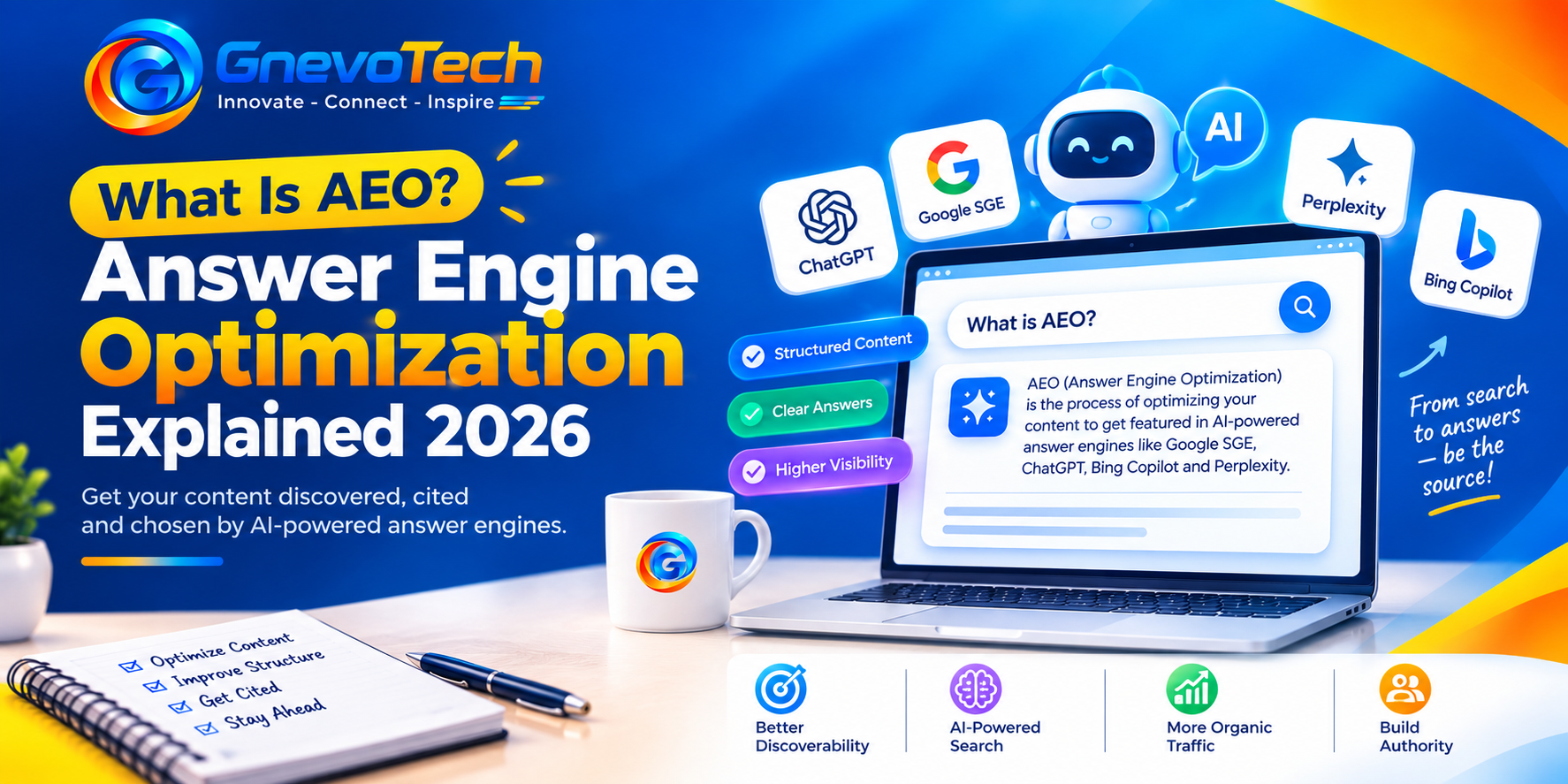
Answer Engine Optimization is the practice of structuring content so AI systems can pull it out and present it as a direct, ready-made answer. Instead of competing for a ranking position, content optimised for AEO competes to be the sentence, paragraph, or data point an AI engine chooses to hand back to the user.
Answer engines include:
- ChatGPT and similar conversational AI tools
- Google AI Overviews and AI Mode
- Perplexity and other research-style AI search tools
- Voice assistants such as Siri and Alexa
- Featured snippets and knowledge panels within traditional search
Each of these systems works differently under the hood, but they share one behaviour. They read content, extract the relevant part, and deliver it as a finished response rather than a list of pages to click through.
Why AEO Matters Right Now
Search habits have shifted more in the last few years than in the previous two decades combined. A large share of queries on Google already end without a click, and that share keeps growing as AI-generated answers take up more space at the top of the page.
We see three consequences of this shift play out for the businesses we work with:
- Visibility no longer equals ranking. A page can rank on page one and still be invisible if an AI engine never selects it as the answer.
- Trust is built before the click, not after it. Customers often form an opinion about a brand from the AI’s summary alone, long before visiting the website.
- Competitors who move early gain compounding advantage. AI systems tend to keep citing sources they have already learned to trust, which makes early, consistent AEO work pay off over time.
Businesses that treat this as optional risk losing ground to competitors who structure their content to be extracted, even if their overall domain authority is lower.
How AEO Actually Works
Answer engines do not evaluate a page the way a traditional search algorithm does. Rankings, backlinks, and keyword density still matter, but they are only part of the picture. Three additional layers determine whether content gets selected as the answer.
1. Content Structure
AI systems favour content that answers a question clearly, near the top of the page, without requiring the reader to piece information together. A direct answer followed by supporting detail performs far better than a long introduction that delays the point.
2. Technical Signals
Structured data plays a bigger role in AEO than it ever did in traditional SEO. FAQ schema, HowTo schema, and clean semantic HTML give AI crawlers a reliable map of what a page contains and how its parts relate to each other.
3. Brand and Trust Signals
Answer engines lean on consistency. A business that is described the same way across its own site, review platforms, directories, and third-party mentions is easier for an AI system to trust and cite confidently. Inconsistent or outdated information works against a brand here.
AEO vs Traditional SEO: The Practical Difference
The two disciplines share the same foundation — quality content, credible authority, and technical cleanliness — but they optimise for different outcomes.
| Factor | Traditional SEO | AEO |
| Goal | Rank high in search results | Become the direct answer |
| Success metric | Position, organic traffic | Citation, extraction rate |
| Content style | Keyword-focused, broad coverage | Question-first, answer-first |
| User outcome | Click through to the website | Answer received directly, with or without a click |
Neither approach replaces the other. Strong SEO builds the authority that makes AEO possible, while AEO extends that authority into a surface where clicks may never happen at all.
Our Approach to AEO Services
As an AI SEO Agency in Jaipur, our AEO Services are built around a repeatable process rather than one-off fixes, because answer engines reward consistency over time.
Step 1 — Question Mapping We identify the exact questions a business’s real customers ask, using search data, customer support logs, and competitor gap analysis.
Step 2 — Answer-First Content Design We restructure or create content so the direct answer appears immediately, followed by supporting context, examples, and detail.
Step 3 — Structured Data Implementation We apply FAQ, HowTo, and Organization schema so answer engines can parse content accurately and attribute it correctly.
Step 4 — Consistency Audits We check how a brand is described across its own website, directories, and third-party platforms, and correct mismatches that reduce trust.
Step 5 — Ongoing Monitoring We track how often a brand’s content gets cited or extracted across major AI platforms and adjust content where visibility gaps appear.
This process sits alongside our broader AI SEO Services and GEO Services, since strong AEO work tends to strengthen citation performance across generative engines as well.
Which Answer Engines Matter Most for Your Business
Not every answer engine carries the same weight for every industry, so we prioritise differently depending on where a business’s customers actually search.
For consumer-facing businesses, Google’s AI Overviews and voice assistants tend to carry the most weight, since everyday purchase questions (“best dentist near me,” “how much does X cost”) are asked there most often.
For B2B and research-heavy industries, ChatGPT and Perplexity carry more influence, because buyers use them to compare vendors, understand technical concepts, and shortlist options before ever visiting a website.
For local service businesses, structured data tied to location, hours, and services matters heavily, since these engines lean on that information to answer “near me” and comparison-style queries accurately.
Understanding this distinction changes where we invest effort first. A national SaaS brand and a local clinic need very different AEO priorities, even though the underlying techniques overlap.
What Answer-Ready Content Actually Looks Like
Content built for AEO reads differently from content built purely for rankings. A few practical patterns make the difference:
- The first sentence answers the question. No lengthy setup, no scene-setting — the answer comes first, detail follows.
- Headings are phrased as questions. This matches how people phrase queries to AI assistants and voice tools.
- Data and specifics replace vague claims. Numbers, timeframes, and concrete details give an AI system something firm to extract and cite.
- One idea per section. Answer engines extract cleanly defined chunks of content, so mixing multiple ideas into one paragraph reduces the odds of a clean extraction.
- Definitions stay tight. A one- or two-sentence definition near the top of a page performs better than one buried three paragraphs in.
We apply these patterns consistently across the content we build, rather than treating them as an occasional add-on to existing pages.
A Realistic Example
A service business offering pest control, for instance, might currently rank for “pest control company [city]” without ever appearing when someone asks an AI assistant, “how do I get rid of ants in my kitchen.” That second query is exactly where AEO earns its value — a well-structured page answering the specific question, backed by clear steps and FAQ schema, gives that business a genuine shot at being the cited source, even against larger competitors with stronger domain authority.
This pattern repeats across nearly every industry we work with. The businesses winning AI visibility are rarely the largest ones. They are the ones answering the exact question a customer typed or spoke, in the clearest possible way.
Common AEO Mistakes We See
Several patterns show up repeatedly across websites that struggle to gain AI visibility:
- Burying the answer. Long introductions before the actual answer reduce extraction odds significantly.
- Treating schema as optional. Pages without FAQ or HowTo markup miss an easy, low-cost signal that answer engines rely on.
- Inconsistent brand descriptions. Conflicting information across platforms makes an AI system less confident in citing a source.
- Writing for keywords instead of questions. Content built around a keyword phrase rather than a real question tends to underperform in answer extraction, even when it ranks well.
- Ignoring freshness. Answer engines favour recently updated, accurate information over older pages that have not been revisited.
Measuring AEO Success
Traditional ranking reports do not capture AEO performance well, so we track a different set of signals:
- Citation frequency — how often a brand’s content is referenced across AI platforms for relevant queries
- Featured snippet and AI Overview appearances — direct visibility within Google’s own answer surfaces
- Schema performance — whether structured data is being read and used correctly by search and AI crawlers
- Question coverage — the percentage of a business’s core customer questions that have a clear, extractable answer on the website
Reviewing these metrics alongside traditional traffic and ranking data gives a fuller picture of where a brand actually stands in AI-driven search. We typically build this into a monthly report so a business can see AEO progress the same way it already tracks organic rankings, rather than treating it as a separate, disconnected effort.
Conclusion: Becoming the Answer, Not Just a Result
Search has moved past the era where ranking alone guaranteed visibility. Customers now expect a direct answer, and the businesses that provide it — clearly, accurately, and consistently — are the ones AI systems keep choosing to cite.
We help businesses make that shift through structured content, clean technical signals, and consistent brand presence across the web. If your business is ready to move beyond rankings and start becoming the answer itself, our team at Gnevotech is ready to build that strategy with you.
Frequently Asked Questions
Is AEO the same as GEO?
They overlap but are not identical. GEO covers any mention or citation inside a generated AI response, while AEO is narrower and focuses specifically on becoming the primary, extracted answer. Every strong AEO result tends to support GEO performance as well.
Does AEO replace the need for SEO?
No. AEO builds on the authority and technical health that SEO already establishes. A site with weak SEO foundations rarely performs well in AEO, regardless of how well its content is structured.
How long does AEO work take to show results?
Most businesses begin seeing measurable citation and extraction gains within a few months of consistent, structured content work. Because AI systems update their sources periodically, results tend to build gradually rather than appear overnight.
Can small businesses compete in AEO?
Yes. Answer engines reward clarity and structure more than sheer domain size, which gives smaller, well-organised websites a genuine chance to be selected as the answer for the specific questions their customers ask. In several cases we have handled, a small business with a tightly structured FAQ page has outperformed a much larger competitor simply because its content answered the question more directly.
Do I need a developer to implement AEO changes?
Not necessarily. Much of AEO work involves rewriting and restructuring existing content, along with adding schema markup, which most content management systems support without custom development. Larger technical changes, such as site-wide schema templates, may need light developer involvement, but the bulk of the work sits with content and structure.