A customer asking ChatGPT “who’s the best dentist in Jaipur” gets a direct recommendation, not a page of links to scroll through. If a business isn’t part of that answer, it never enters the conversation at all. This shift is what Generative Engine Optimisation was built to address, and at Gnevotech, it has become one of the most requested services we deliver, because it changes how a business gets found at the exact moment someone is deciding.
This guide explains what GEO actually means, how generative engines choose what to cite, and the practical work involved in earning that citation consistently.
What Does GEO Mean?
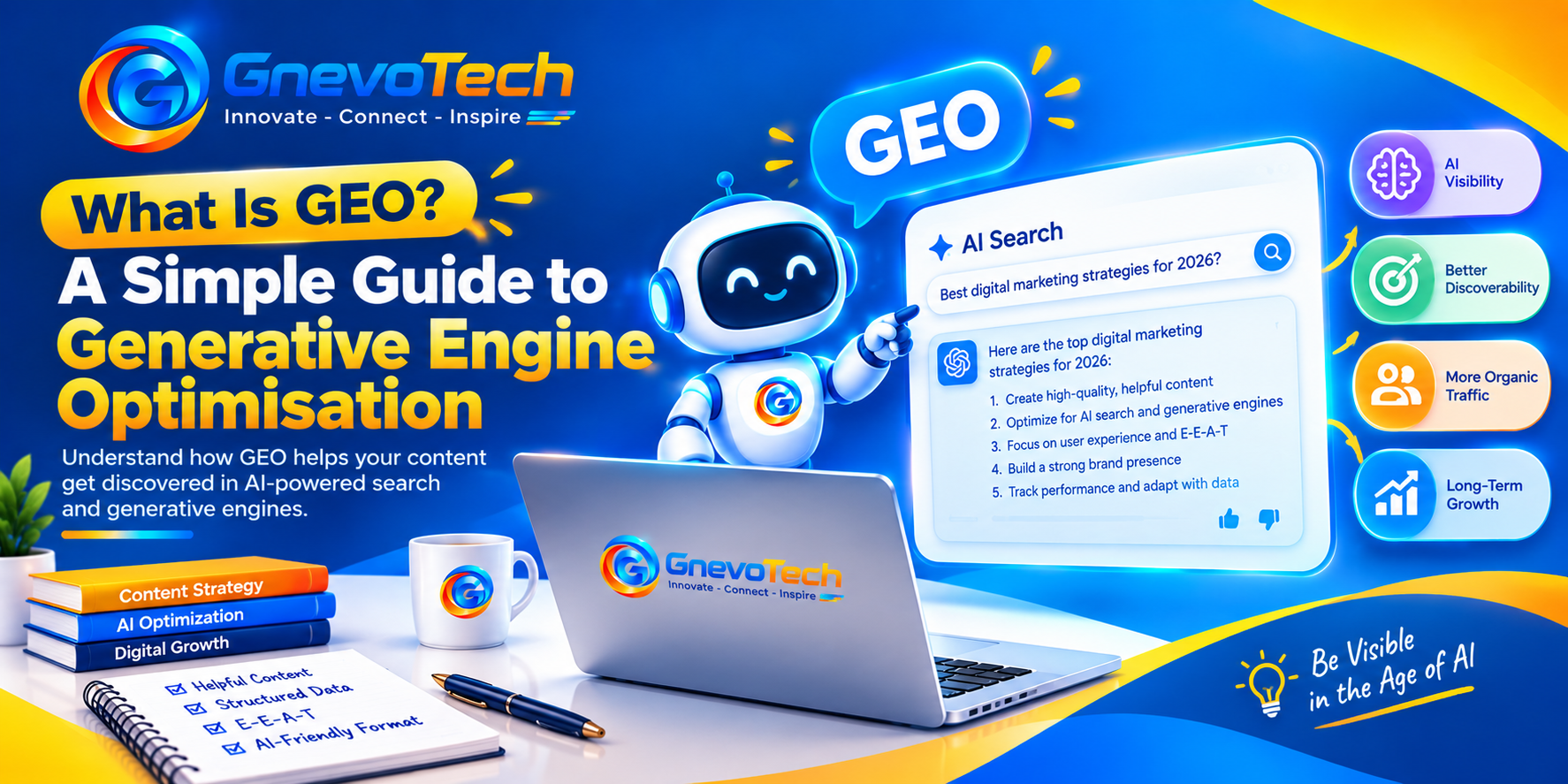
Generative Engine Optimisation is the practice of structuring content and building authority so that AI systems such as ChatGPT, Perplexity, Gemini, and Google AI Overviews choose to cite a business when answering a relevant question. Where traditional search rewards a ranking position, generative engines reward being part of the synthesised answer itself.
The distinction is simple to hold onto:
- SEO earns a click. A page ranks, a user clicks, and traffic arrives at the website.
- GEO earns a mention. A business’s information gets pulled into an AI-generated answer, often without any click at all.
Both outcomes matter, but they require different work to win, which is why our GEO Services exist as a distinct discipline rather than a rebranded version of traditional SEO.
How Generative Engines Actually Choose What to Cite
Understanding the mechanics behind generative search explains why GEO requires a different approach than ranking on Google.
Query Fan-Out
When someone asks an AI assistant a question, the system typically does not run one simple search. It breaks the question into several related sub-queries, searches across multiple angles, and then pulls together the strongest passages it finds. This means a business needs relevant content covering the different ways a question might be asked, not just one exact-match page.
The Passage Is the Unit of Value
Traditional SEO treats the page as the unit that ranks. GEO works differently. A generative engine can cite a single well-written paragraph from deep within a long article, while ignoring the rest of the page entirely. This means every section of a page needs to stand on its own as a citable, self-contained answer, rather than relying on the reader to have followed the argument from the top.
Trust Signals Decide the Winner
With several candidate sources answering the same question, generative engines lean on trust signals to choose between them — consistency of information across the web, specificity of the claim, and evidence backing it up. A vague, generic statement rarely gets cited. A precise, well-supported one often does.
Why GEO Matters for Businesses Right Now
AI-assisted search is no longer a niche behaviour. A meaningful share of research and comparison queries already happen through conversational AI tools rather than a traditional search bar, and that share continues to grow.
We see three consequences play out consistently for the businesses we work with:
- Citation does not require top rankings. Generative engines frequently cite pages that sit outside the top ten organic results, which means smaller or newer websites have a genuine opportunity here.
- Being early compounds. AI models tend to keep citing sources they have already learned to trust, so businesses building GEO visibility now have a head start that becomes harder for competitors to close later.
- Invisibility is expensive. A customer who receives a confident AI answer with no mention of a business rarely goes looking further. The opportunity is lost before a website visit was ever possible.
The Specific Techniques That Improve GEO Performance
Several tactics consistently strengthen how often a business gets cited across generative engines.
Write Specific, Citable Statements
A vague claim rarely gets pulled into an answer. A precise, standalone statement does. Instead of saying a service “helps businesses grow,” stating exactly what it does, for whom, and with what measurable outcome gives an AI system something concrete to cite.
Include Data, Quotes, and Named Evidence
Numbers anchor a claim, and named sources add credibility. Original statistics, case study results, and direct quotes from real people carry more weight than generic assertions, largely because they cannot be easily replicated by a competitor’s content.
Target Conversational, Long-Tail Questions
Generative engines respond to natural language questions rather than short keyword phrases. Content built around “how do I choose a calibration management system for a small manufacturing team” performs better in this context than content built purely around a short keyword like “calibration software.”
Strengthen Entity and Structured Data
Schema markup, consistent business information, and clear “about” content help AI systems understand exactly what a business does and who it serves. This reduces ambiguity at the exact moment a generative engine is deciding whether a source deserves a citation.
Build Presence Beyond the Website
Generative engines draw on sources across the web, not only a business’s own domain. Reviews, directory listings, forum discussions, and third-party mentions all feed into how confidently an AI system cites a brand. Consistency across these sources strengthens trust far more than perfecting a single page in isolation.
Keep Technical Access Open
AI crawlers need to reach and read a page just as search engine bots do. Blocking crawlers through overly restrictive robots.txt rules, or relying on content that only loads through heavy JavaScript, can quietly remove a business from consideration entirely.
How Our GEO Services Work
As a GEO Agency in Jaipur, we build this work as a structured, ongoing process rather than a single content rewrite.
Step 1 — Visibility Audit We test how a business currently appears across ChatGPT, Perplexity, and Google AI Overviews for its core questions, identifying where it is cited, missing, or described inaccurately.
Step 2 — Content Restructuring We rewrite key pages so each section stands alone as a specific, evidence-backed answer, rather than depending on surrounding paragraphs for context.
Step 3 — Entity and Schema Strengthening We apply structured data and tighten “about” and service-page content so AI systems can describe a business accurately and confidently.
Step 4 — Off-Site Consistency We review and correct how a business is described across directories, review platforms, and third-party mentions, since inconsistent information undermines trust signals generative engines rely on.
Step 5 — Ongoing Citation Monitoring We track citation frequency and accuracy across major AI platforms over time, adjusting content as models update their source preferences.
This process runs alongside our AEO Services and broader SEO Services in Jaipur, since strong GEO work tends to reinforce visibility across all three surfaces at once.
Common Mistakes That Limit GEO Visibility
A few patterns show up repeatedly across businesses that struggle to get cited.
- Treating GEO as a one-time project. Because AI models retrain and update their sources, citation visibility needs ongoing attention rather than a single push.
- Writing vague, marketing-style claims. Generic language rarely gets cited, no matter how polished it reads.
- Ignoring off-site consistency. A business can have a strong website and still struggle if its information is inconsistent or outdated elsewhere on the web.
- Overlooking technical accessibility. Content an AI crawler cannot reach or parse never has a chance to be cited, regardless of quality.
- Chasing rankings instead of citations. A page can rank well on Google while remaining invisible inside generative answers, since the two surfaces evaluate content differently.
How GEO, AEO, and SEO Fit Together
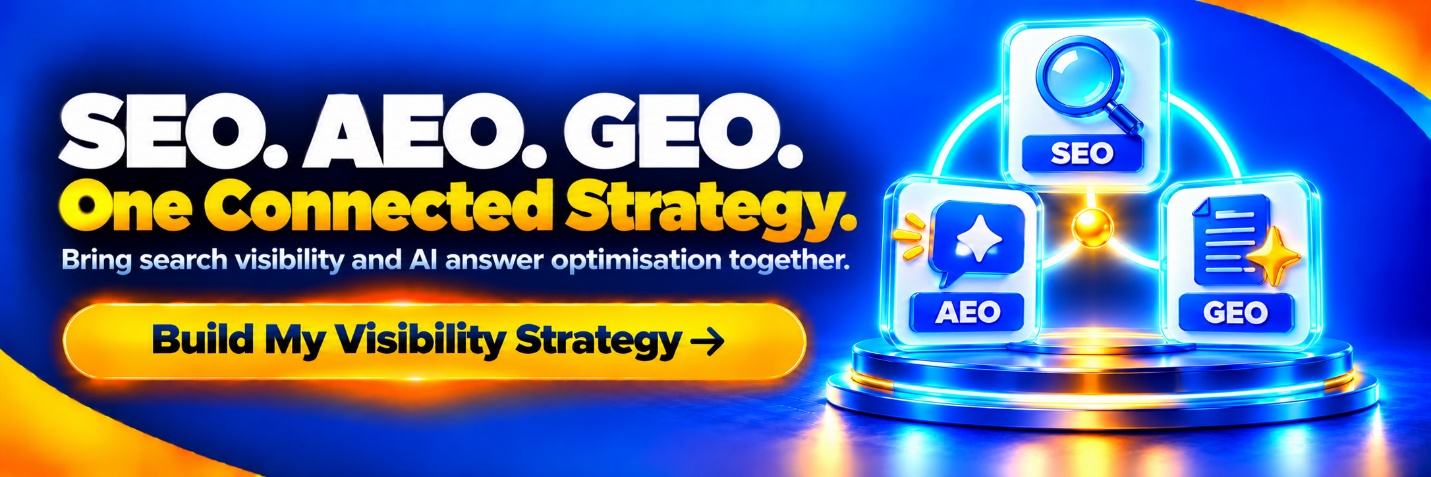
These three disciplines are often discussed separately, but they draw on much of the same underlying work. Strong technical health, clear content structure, and credible authority signals support all three at once.
The difference sits in the specific surface each one targets. SEO competes for a ranking position on a results page. AEO competes to become the single, direct answer to a specific question. GEO competes to be one of several sources cited within a broader, synthesised response. A business rarely needs to choose only one. Most benefit from building all three into a single content and authority strategy, since the overlap in underlying work means the marginal cost of covering all three is far lower than building each in isolation.

Measuring GEO Performance
Standard analytics tools were not built to track AI citations, so measuring GEO requires a different set of signals.
- Citation frequency — how often a business’s content or brand name appears inside AI-generated answers for relevant questions.
- Citation accuracy — whether the information an AI system presents about a business is current and correct.
- Share of voice against competitors — how a business’s citation rate compares to direct competitors answering the same category of question.
- Source diversity — whether citations come only from the business’s own website, or also from third-party mentions, reviews, and directories that reinforce trust.
We review these signals on a recurring basis, since citation patterns shift as AI models retrain and as competitors publish new content of their own.
A Practical Example
A client offering equipment calibration software previously had strong Google rankings but no presence inside AI-generated answers for closely related questions. Testing revealed the issue: the website’s “about” content was generic, and third-party directories listed inconsistent descriptions of what the software actually did.
Rewriting the core service pages around specific, evidence-backed statements, correcting directory listings, and adding structured data led to the business appearing as a cited source within AI Overview responses for several target questions within weeks, without any change to its existing Google rankings.
Conclusion: Earning a Place Inside the Answer
Search no longer ends with a list of links for a growing number of customers. It ends with a generated answer, and the businesses that shape up as part of that answer are the ones customers act on. Ignoring this shift does not make it slower. It only means competitors who adapt first capture the advantage while the field is still uncrowded.
We help businesses build that advantage through structured content, consistent off-site presence, and ongoing citation monitoring. If your business is ready to move beyond rankings alone and start earning a place inside the answers your customers are already asking for, our team at Gnevotech, recognised as the Best GEO Agency in Jaipur by the clients we work with, is ready to help.
Frequently Asked Questions
How is GEO different from SEO?
SEO focuses on ranking a page within traditional search results, measured through traffic and position. GEO focuses on being cited inside an AI-generated answer, measured through citation frequency, and does not require a top ranking to succeed.
Is GEO the same as AEO?
They overlap but are not identical. GEO covers any citation or mention inside a generative AI response, while AEO focuses more narrowly on becoming the single, direct answer to a specific question. Strong GEO work generally supports AEO performance as well.
How long does it take to see GEO results?
Citation gains can appear faster than traditional ranking improvements in some cases, since generative engines update their source preferences more frequently than Google’s core ranking algorithm shifts. Most businesses see measurable movement within a few weeks to a few months of consistent work.
Can a small business realistically compete for AI citations?
Yes. Citation does not depend heavily on overall domain size or authority. A smaller business with specific, well-evidenced content and consistent information across the web often has a genuine chance against larger, less precise competitors.