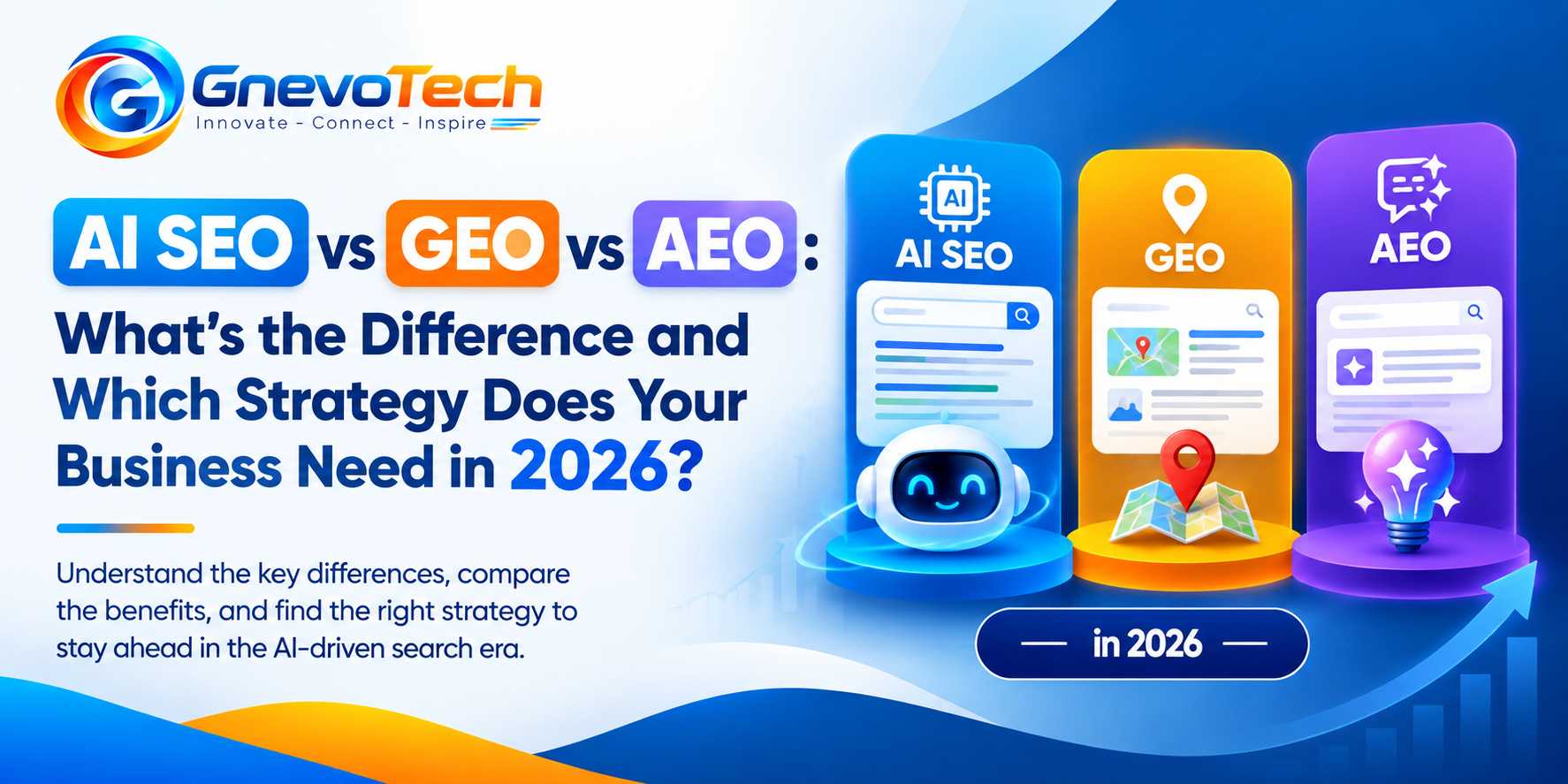
Search behaviour just isn’t what it was two years ago. Barely anyone types a query and scrolls through ten blue links these days. Most people ask a chatbot something and expect one direct answer, no scrolling involved. That’s more or less why three terms keep coming up in every conversation now — AI SEO, GEO, and AEO. We get asked about this constantly at Gnevotech. A lot of the time it’s simply “what does this term even mean?” Other times it goes deeper — whether a business genuinely needs all three, or if just one covers what they’re after.
Below, each strategy gets broken down in plain language. The overlaps get pointed out along the way too, so by the end you’ll have a decent sense of the right mix for your own site.
What Is AI SEO?
AI SEO is the umbrella term, really. It’s search optimisation that also factors in how AI now shapes discovery. Everything traditional SEO already handles well — technical health, keyword targeting, backlinks, solid content — stays intact. On top of that sits a layer built specifically for AI-driven search.
Our AI SEO Services at Gnevotech generally cover:
- Technical audits for crawlability, both for regular search bots and AI crawlers
- Content structured so people and machines can both make sense of it fast
- Entity and topical authority building across a site
- On-page optimisation that still respects the older ranking factors
AI SEO works as the foundation. It keeps a business visible on Google, and at the same time preps that same content to hold up inside AI-generated experiences.
Why AI SEO Still Matters
Google hasn’t gone anywhere. Millions of transactional and local searches still run the old way, every day, without fail. A business that drops classic SEO entirely just to chase AI trends risks the traffic it’s already earned. AI SEO protects that base while stretching reach into the newer surfaces.
What Is GEO (Generative Engine Optimization)?
GEO has one job: get a brand mentioned, cited, or summarised inside tools like ChatGPT, Gemini, Perplexity, and Copilot. These tools skip ranking pages altogether — they pull an answer together from several sources and pick which ones deserve a mention.
Our GEO Services focus on:
- Building clear, well-sourced content that AI models can pull from with confidence
- Strengthening entity signals so AI systems actually know what a business does
- Publishing in the formats generative engines tend to cite — definitions, comparisons, data points, expert explanations
- Watching how a brand currently shows up, or fails to, inside AI answers
An AI model works a bit like a very well-read editor here. Ranking position isn’t the point. Getting chosen as the quote is.
Where GEO Delivers Value
Someone researching a purchase through an AI assistant might never open a search results page at all. If a brand isn’t part of the material behind that answer, it simply doesn’t exist for that customer — no matter how strong the rankings look elsewhere. GEO closes that gap.
What Is AEO (Answer Engine Optimization)?
AEO is the narrowest of the three. It’s about winning the direct-answer slot — the single response an AI or assistant gives, not one citation among several.
Our AEO Services typically involve:
- Structuring content around the real questions customers ask, in clear Q&A form
- Writing short, confident first answers right at the top of each section
- Applying FAQ and HowTo schema so answer engines can lift content directly
- Formatting for voice search and conversational-style queries
Success here doesn’t look like traditional SEO success. We’re not chasing a spot on a results page. We’re watching how often the content itself becomes the answer.
Why AEO Is Growing in Importance
Voice assistants, AI Overviews, chat-based search — they all lean toward one clean, well-structured answer over a pile of options. A business built for AEO has better odds of being that one answer. That builds trust before a customer even clicks through.
AI SEO vs GEO vs AEO: The Core Differences
Underneath, the three share a lot of the same groundwork — strong content, clean technical structure, credible entity signals. What splits them apart is what each is actually optimising for.
- AI SEO — shows up mainly on Google, Bing, and AI-assisted search. Success gets measured through organic traffic, rankings, and general visibility. The core focus is broad discoverability, across both search and AI.
- GEO — plays out on ChatGPT, Gemini, Perplexity, and Copilot. Success here means citation frequency and how often the brand gets mentioned in AI answers. The core focus is being referenced inside generative responses.
- AEO — targets featured answers, voice assistants, and AI Overviews. Success is measured by extraction rate and direct-answer placement. The core focus is becoming the single quoted answer.
A short version, if you want to remember it fast:
- SEO earns a ranking.
- GEO earns a mention.
- AEO earns the answer.
None of these replace the others. Most businesses need bits of all three, just weighted differently depending on the goal.
Which Strategy Does Your Business Actually Need?
It comes down to how customers currently find and judge your business.
Go with AI SEO first if:
- Organic traffic is still your main growth channel
- Your site has technical gaps or thin content that needs fixing
- You want a solid base before adding AI-specific work on top
Prioritise GEO if:
- Customers research decisions using AI chat tools before buying
- Competitors are showing up in AI answers and you aren’t
- Visibility inside AI conversations matters more to you than raw click-through traffic
Put effort into AEO if:
- Customers keep asking the same specific questions about your product or service
- You depend heavily on local or voice search
- You want a spot inside AI Overviews and featured answer boxes
Most businesses we work with need a blend, honestly. A local service business might lean into AEO for question-based queries. An ecommerce brand might push AI SEO for category pages and GEO for product comparison content.
How Gnevotech Builds an Integrated Strategy
As an AI SEO Agency in Jaipur, we don’t split AI SEO, GEO, and AEO into separate departments. We build them as one connected strategy. Search engines and AI systems increasingly draw from the same underlying signals anyway — clean technical structure, clear entity information, content written to answer real questions.
Our process generally runs in four steps:
- Audit — Current visibility gets checked across both traditional search and AI platforms, so the gaps are clear from the start.
- Structure — Technical issues get fixed, and content gets reorganised around topics and entities instead of just keywords.
- Optimise — Content is written and formatted for rankings, citations, and direct answers, all together.
- Monitor — We keep an eye on how a brand appears across Google, AI Overviews, and generative engines, and adjust things as these platforms keep shifting.
This layered approach means a business isn’t stuck picking one strategy over another. Every piece of content ends up working across search results, AI citations, and direct-answer boxes at once.
What Happens If a Business Ignores AI Search
Businesses sticking to only traditional SEO aren’t making a mistake exactly. They’re just covering one surface out of three. The risk, though, doesn’t show up overnight. It creeps in slowly, bit by bit.
Picture a customer researching a service today. They open an AI assistant instead of a search bar. Without a reliable source to draw from, that assistant either skips the business entirely, or worse, pulls outdated or wrong details from somewhere else. Neither outcome helps the brand.
This pattern tends to show up in competitive industries especially, where several providers offer nearly identical services. More often than not, whichever business appears inside an AI-generated comparison or recommendation ends up winning the inquiry before the customer has even opened a website. A plain results-page ranking just doesn’t capture that kind of pull.
Traditional SEO hasn’t lost its value here. It’s just that visibility is now a three-front battle instead of one, and a business fighting on only one front leaves real chances sitting on the table.
Measuring Success Across AI SEO, GEO, and AEO
Each one needs its own way of being measured. Success looks different in every case.
For AI SEO, we track:
- Organic sessions and keyword rankings
- Technical health scores — crawl errors, indexation, Core Web Vitals
- Growth in topical and entity authority over time
For GEO, we track:
- How often the brand gets mentioned across major AI platforms
- Sentiment and accuracy in how the brand gets described in AI outputs
- Share of voice against direct competitors inside AI answers
For AEO, we track:
- How often content gets pulled into featured answers or AI Overviews
- How FAQ and HowTo schema perform in search results
- Visibility across voice and conversational queries
Put all three together and you get a fuller picture than any single metric on its own could offer. A page might rank well on Google while being nowhere to be found in AI-generated answers — and just as often, it works the other way round. Tracking each surface separately is really the only reliable way to spot where the actual gaps sit.
Content That Works Across All Three Surfaces
One upside of treating AI SEO, GEO, and AEO as connected, rather than separate, is that well-built content tends to perform across all three without much extra work.
Content written to satisfy AEO — clear, direct, well-structured answers — also tends to pick up citations under GEO. That’s because generative engines look for the same clarity that answer engines want. Back it up with solid technical SEO, and that same content keeps supporting traditional rankings too.
There’s a flip side to this. Content that’s built purely around chasing keyword rankings, skipping real structure or direct answers, tends to underperform on both fronts — AI citations and answer extraction alike. Search intent, clarity, and structure carry a lot more weight now than keyword density ever did.
That overlap is exactly why we build content once, folding in all three goals from the start, rather than putting together separate versions for each strategy.
Final Thoughts: Building Visibility for the Next Era of Search
AI SEO, GEO, and AEO aren’t rival trends chasing the same buzzword. Each one answers a different question about how customers find and judge a business today — through search rankings, AI citations, or direct answers. A strategy built around just one of these leaves gaps that competitors will happily fill.
We help businesses close those gaps by bringing all three together into one coherent plan. If your business is ready to build visibility across Google, AI Overviews, and generative platforms like ChatGPT and Gemini, our team at Gnevotech is ready to help you get there.
Common Questions
Is GEO the same as AEO?
Not exactly, though the two sit close together. GEO casts a wider net — it counts any mention, citation, or reference that shows up inside a generative AI response. AEO is more specific than that. It’s only concerned with one thing: landing the primary, extracted answer. That means an AEO win automatically works as a GEO win too. It doesn’t run the other direction, though — plenty of GEO mentions never turn into an AEO win.
Does AI SEO replace traditional SEO?
It doesn’t — it builds right on top of it. The backbone stays the same: technical health, quality backlinks, strong on-page content. And in that vein, AI SEO only extends this process, thus taking into account how AI systems find and summarize content.
What is the duration required to get the results of GEO or AEO?
Depends heavily on the industry and how crowded the competition is, honestly. Timelines swing quite a bit because of that. Put in a few months of steady, structured content work, though, and most businesses notice some kind of change in how they show up in AI. Part of the reason it’s gradual comes down to how AI models operate — they retrain and refresh their sources periodically, not instantly, so GEO and AEO gains tend to build layer by layer rather than land in one go.
Can a small or local business benefit from AEO?
Yes, and often more than the bigger competitors, actually. Local businesses tend to field a narrow, fairly predictable set of customer questions, which makes them a genuinely good fit for structured AEO content and FAQ schema.