
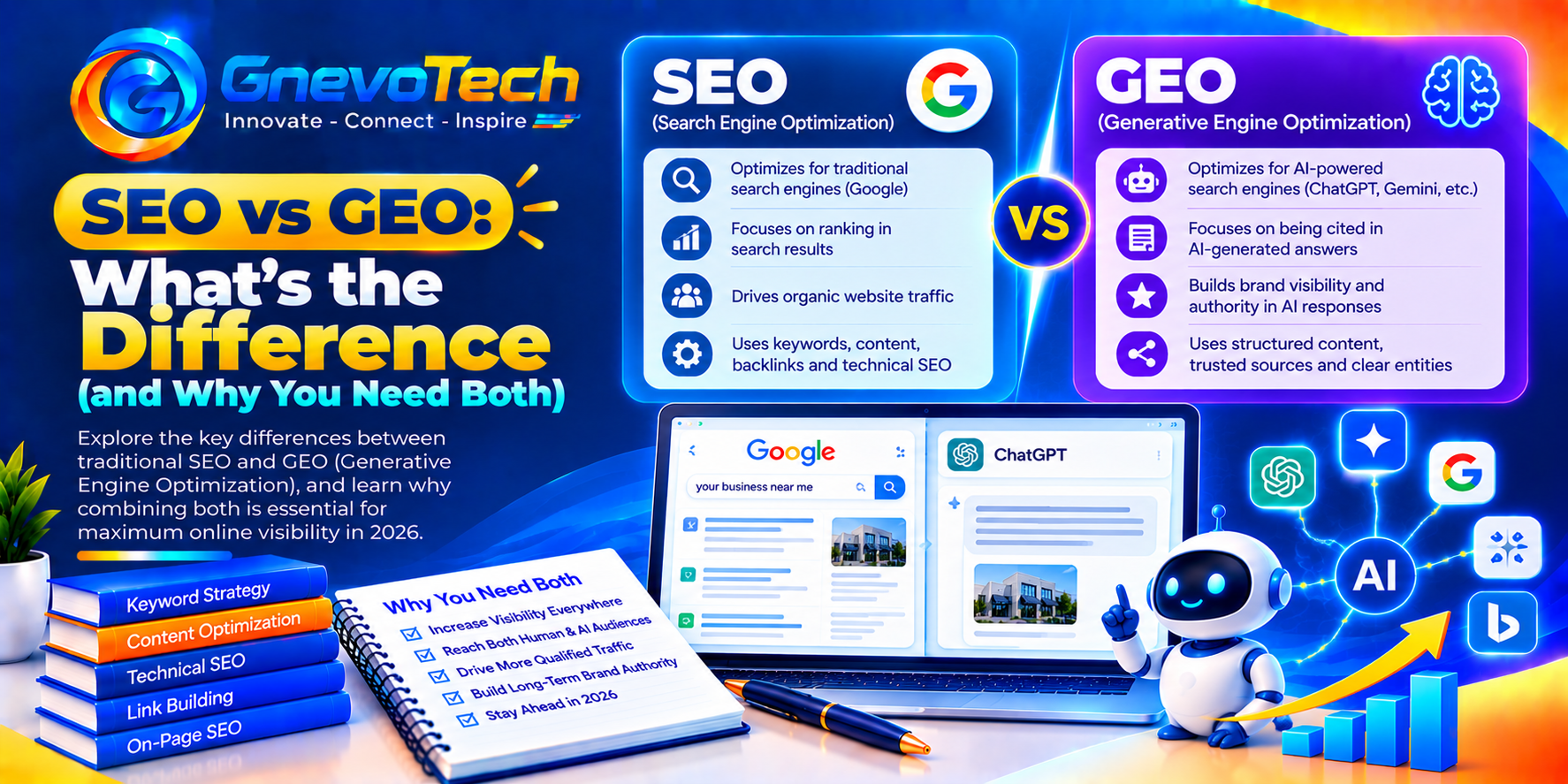
Last month, a dentist in Jaipur showed us two screens. On the first, her clinic sat in the top three on Google for a local search. On the second, she had typed the same question into an AI assistant, in plain words, the way a patient would. Her clinic wasn’t mentioned at all. A competitor she’d never worried about was. She hadn’t done anything wrong. She was simply winning one game while her patients had started playing another. That gap is what SEO vs GEO is really about, and it matters to any business that wants to be found.
Here’s how we explain it, in plain words.s
What SEO actually does
Search engine optimization helps your pages show up when someone types a query into a search engine. The aim is a click. A person sees your link, visits your site and decides what to do next.
- It works on pages, keywords, links and technical health
- It targets a place in the list of results
- It is measured in visits, positions and inquiries
- It has years of tools, case studies and shared experience behind it
Nothing about GEO makes this old-fashioned. People still search the usual way, and they still click.
What GEO means
GEO stands for generative engine optimization. It’s the work of making your brand and content easy for AI answer tools to understand, trust and mention. These tools write a direct reply instead of showing a list of links, so the goal shifts. You want to be part of the answer itself.
Take two situations:
- A person types “dentist near me” into a search engine and scans ten links
- A person asks an AI assistant, “Which clinic in Malviya Nagar is good for a nervous child?” and reads one written reply
In the second case, nobody scrolls. If you aren’t named or cited, you simply don’t exist for that moment.
A side-by-side look
| Point | SEO | GEO |
| Where it shows | Search result pages | AI-written answers and summaries |
| What you earn | A ranking and a click | A mention, a citation or a recommendation |
| What matters most | Relevance, links, page quality | Clarity, trust signals, consistent facts about your brand |
| Typical question | Short keywords | Longer, conversational questions |
| How you measure | Rankings and traffic | Mentions and brand visibility, which is harder to track |
The two overlap far more than they differ. Good GEO usually rests on good SEO.
How AI tools tend to pick what they say
We should be careful here. These systems change often, and each one works differently. Nobody outside the companies that build them knows the exact recipe. Still, a few patterns are widely observed.
- Many AI tools draw on web content that is easy to find, read and verify
- Clear, direct answers to specific questions are easier for them to use
- Consistent facts about a business across several sites build confidence
- Content from sources that look knowledgeable and trustworthy tends to be preferred
- Fresh, accurate information matters when a topic changes quickly
An honest limit: no one can promise that a particular page will be quoted by an AI tool. Anyone who does is overselling.
Practical steps that help with GEO
Most of these are sensible habits. You can start today without any special tool.
- Answer real questions plainly. Put a short, direct answer near the top, then add detail below it.
- Keep your business facts consistent. Name, address, phone number, services and hours should match everywhere they appear.
- Use clear headings and structure. Machines and people both skim.
- Add structured data where it fits. It helps systems understand what a page is about.
- Show real expertise. Name your authors, share credentials and use examples from actual work.
- Earn mentions elsewhere. Reviews, directories, news pieces and partner pages all help.
- Update older pages. Stale facts weaken trust.
Notice that none of this is a trick. These are the same habits that make a site useful to humans.

When outside help makes sense
Some teams can do all this in-house. Others don’t have the time or the right mix of skills. If you’re looking at GEO services, ask what the work really involves before you pay anyone.
- What will they change on your site, and what will they create from scratch?
- How will they check whether AI tools mention you, and how often?
- How do they deal with the fact that these systems keep changing?
- Will you get plain reports, or only dashboards full of charts?
- What do they say they cannot control?
A good provider answers without drama. A weak one leans on slogans and promises.
Why you need both
Here’s the simplest way to see it. SEO helps people find you when they search. GEO helps AI tools understand and mention you when they answer. Your customers use both, sometimes within the same hour.
- A person might ask an AI assistant for options, then search your name to double-check you
- Someone might search first, then ask an assistant to compare two results
- A third person might never touch an AI tool and still find you through an ordinary search
If you invest in only one, you leave part of the journey to chance.
How the two work together
Your SEO foundation does a lot of the heavy lifting. A fast, accurate, well-built site with helpful pages gives AI tools better material to work with. In the same way, a clearly explained brand with consistent facts across the web helps search engines trust you too.
- Fix technical problems that stop pages from being found
- Write pages that answer real questions in full
- Keep your facts consistent across your site and listings
- Collect honest reviews and mentions
- Check what’s working every month and adjust
This isn’t two separate projects. It’s one project seen from two angles.
Where AI-focused SEO fits in
Many agencies now bundle both under one heading. When people ask about AI SEO services, they usually want support that covers traditional rankings and visibility in AI answers together. The label matters less than what’s inside it.
Ask for specifics:
- Which parts are traditional SEO, and which are new work for AI answers?
- What would the first ninety days look like?
- What will you receive each month, in plain terms?
- How do they separate real progress from noise?
Be careful with promises like “guaranteed placement in AI answers.” Nobody controls that.
Measuring results without fooling yourself
Measurement is the awkward part of GEO. Search rankings are easy to check. AI answers vary by wording, by user and even by day, so a single test proves very little.
- Track a set of real questions your customers ask, and check them regularly
- Note whether your brand is named, linked or described correctly
- Watch branded searches, since people often look up a name they saw in an answer
- Keep an eye on referral traffic from AI tools, where it shows up in your analytics
- Look at inquiries and sales, not only visibility
Treat these numbers as signals, not proof. Patterns over several months tell you far more than one screenshot.
The local angle for businesses
Local businesses have a real advantage here, because so many questions include a place: a clinic, a coaching class, a restaurant, a factory or a boutique. Clear local details help both search engines and AI tools.
If you’re comparing SEO services in Jaipur, a few questions are worth asking:
- Do they understand your customers’ real questions, including those typed in Hinglish?
- How will they manage your Google Business Profile and local listings?
- Can they show work for businesses like yours, with context?
- How do they report on both rankings and AI visibility?
Local trust signals, such as consistent listings, genuine reviews and a clear service area, help in both worlds.
Mistakes we see often
- Treating GEO as a replacement for SEO instead of an extension
- Chasing every new tool before the basics are right
- Stuffing pages with phrases written for machines
- Letting business details drift between websites and listings
- Expecting instant results, when trust takes time to build
- Paying for guarantees that nobody can honestly give
Most of these come from impatience. Steady work wins.
A simple thirty-day starting plan
You don’t need a large budget to begin.
- Week one: Audit your site and listings. Fix any wrong or inconsistent business details.
- Week two: Write down twenty real questions your customers ask. See how your pages answer them.
- Week three: Rewrite your five most important pages with clear, direct answers and better structure.
- Week four: Ask for a few honest reviews, and check how your brand appears in a handful of AI answers.
Repeat this cycle every month. Small, regular improvements add up.
Conclusion: One Goal, Two Paths to It
SEO and GEO aren’t rivals. One helps people find you in search results. The other helps AI tools understand and mention you in their answers. Your customers move between both, so a business that wants to be found should care about both. Build a strong site, keep your facts consistent, answer real questions clearly and be wary of anyone promising certainty in a field that keeps changing.
At Gnevotech, we help businesses think about search and AI answers together, so being found doesn’t depend on which screen a customer happens to be using.
Frequently Asked Questions
1. What is the primary difference between SEO and GEO?
SEO involves ranking your pages to get clicks from users. GEO involves making your brand understandable by the AI systems that produce answers.
2. Is GEO supposed to replace search optimization?
No, these processes have some intersections. Good search optimization usually leads to a successful GEO. Both are useful for most companies.
3. Is there any company that guarantees inclusion in an AI answer?
No, all the systems are very different and keep changing. A good provider tells you what they can do and what they cannot.
4. Can a small business implement a GEO strategy without a huge budget?
Yes, it starts with fixing inconsistent information about your business, answering your customers’ queries on your main pages, getting authentic reviews, and monitoring your presence.