
A furniture showroom owner on Tonk Road told us he had switched on a Google campaign “that does everything” and then stopped looking at it. Two months later, his invoice had grown and he couldn’t say where the money went. Some of it had gone to people searching his brand name, who would have found him anyway. Some had gone to display placements he’d never seen. He wasn’t careless. He had been told the system would handle it. Many owners in his position start by searching for PPC services, because Performance Max sounds simple and behaves like a black box.
Here’s how it works, in plain words, and how to keep a hand on the wheel.
What Performance Max actually is
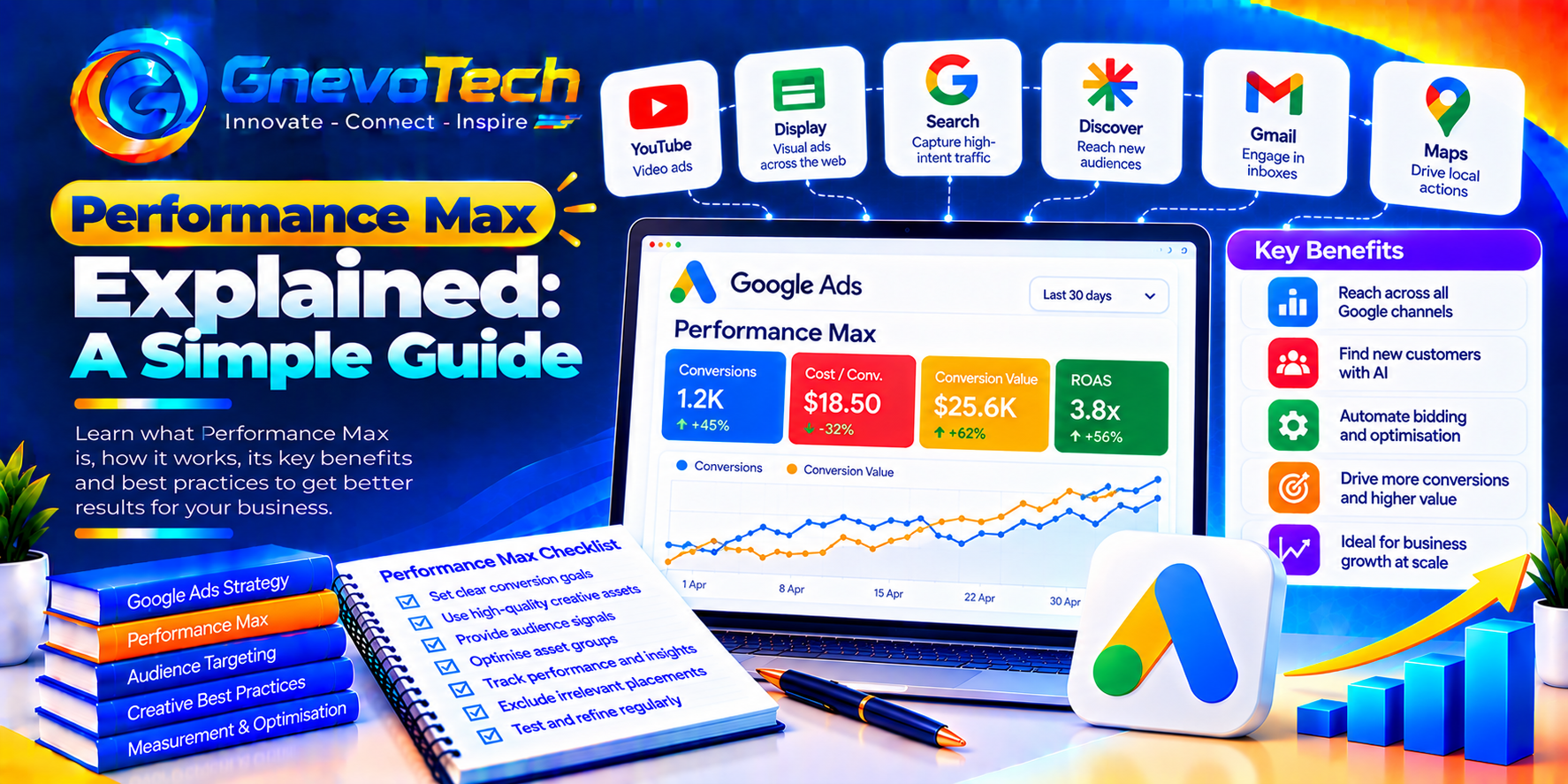
Most Google campaigns run in one place: Search, Display or YouTube. Performance Max runs across all of Google’s channels from a single campaign. That includes Search, YouTube, Display, Discover, Gmail and Maps.
You don’t pick the placements. You give Google your goal, your budget, your creative and some signals about who you want, and its automation decides where to show what.
Think of it as hiring a driver who knows the roads but not your preferences. He’ll get you somewhere quickly. Whether it’s where you meant to go depends on the instructions you gave him.
What you give it, and what it does with it
The system needs four kinds of input.
- A goal: such as leads, calls, store visits or online sales
- Creative: headlines, descriptions, images, logos and, ideally, video
- Signals: your customer lists, audience ideas and search themes that hint at who to find
- A budget: which it spreads across channels as it learns
From these, it mixes and matches assets into ads for different places and shifts spend towards what appears to work. The better your inputs, the better its guesses.
Where it tends to work well
Performance Max is not right for every business. It usually helps most in these situations:
- Online stores with a product feed and clear sales tracking
- Businesses with enough conversions for the system to learn from
- Brands that want reach across several Google channels without managing each separately
- Local businesses that want calls, visits or directions, when tracked properly
It’s less comfortable where data is thin or where you want tight control over exactly where your ads appear.
Where it can disappoint
Be honest with yourself about these risks.
- Little control: you see less detail about where and why ads showed
- Data hunger: with few conversions, the system has little to learn from
- Brand overlap: it may spend on searches for your own name, which looks like success but may not be new business
- Weak creative: low-quality images or generic text produce weak ads everywhere
- Messy tracking: if every click counts as a lead, it will chase clicks
None of these makes it a bad tool. They make it a tool that rewards preparation.
Set up the groundwork first
Before you launch, spend an afternoon on the basics.
- Track real conversions, such as calls, bookings or sales, and test that each one records
- Decide what a valuable lead is, and tell the system through your conversion settings
- Prepare good photos, short videos and honest headlines
- Check that your website pages load quickly on a phone and make it easy to inquire
- For shops, keep your product feed accurate, with clear titles, prices and stock
Weak groundwork turns automation into a very efficient way of wasting money.
If you’d rather not run it alone
Plenty of owners handle campaigns themselves. Others want someone to watch the settings, creative reports, and everything every week. If you’re comparing a PPC agency in Jaipur, ask a few plain questions:
- How do you decide whether Performance Max suits my business?
- What will you do to keep brand searches from inflating results?
- Will the account be in my split item, with full access for me?
- How will you report on real customers, not just clicks?
- Which parts of this can you not control?
A good agency explains trade-offs openly. A weak one says the machine will take care of it.
Asset groups and signals, explained simply
An asset group is a bundle of creative aimed at one type of customer or product. Instead of putting everything in one pile, split by theme.
- One group per product category, such as sofas, beds and dining sets
- Headlines and images written for that group, not for everyone
- Audience signals that match, such as past buyers or people searching related terms
Signals are hints, not hard limits. The system may find customers outside them, so treat them as a starting point and watch the results.
Keeping brand searches in check
A common surprise is spending on people who already know you. Someone typing your shop’s name is likely to buy anyway, and counting that as a win flatters the numbers.
- Look at your search terms and placements reports where available
- Use brand exclusions if your account offers them
- Compare new customers against returning ones
- Judge the campaign on new business, not total conversions alone
If most results come from your own name, the campaign is harvesting, not growing.
How to read the results
Performance Max reports are less detailed than older campaigns, so look at the right signals.
- Cost per lead or per sale, compared with what a customer is worth
- Conversion quality: ask your team or check your CRM
- Asset performance, to see which images and headlines pull their weight
- Where spend is going, using the insights available
- Changes over several weeks, not single days
Give it time to learn, and avoid editing it every other day. Constant changes restart the learning.
Local support for Jaipur businesses
Many Jaipur shops, clinics and showrooms run on a mix of calls, walk-ins, and WhatsApp inquiries. That makes tracking more important, because the system can only chase what it can see. If you want help with setup, tracking and monthly checks without hiring a full team, PPC services in Jaipur can fill the gap. Ask for a written scope, an example of similar work and a clear answer on who owns the account.
Mixing it with other campaigns
Performance Max rarely has to work alone. Many accounts pair it with standard search campaigns, especially for high-intent keywords.
- A search campaign for your best-converting phrases keeps control where it matters
- Performance Max can catch the wider audience and visual placements
- Review both together so you can see whether they overlap or compete
- Decide the split from your numbers, not from a rule of thumb
The right mix differs by business, so test in small steps.
Reading big claims calmly
You’ll see plenty of agencies calling themselves number one, and many promise that automation will do the heavy lifting. When you meet the phrase best PPC agency in Jaipur, treat it as a cue to ask more questions, not as proof. Look for case studies you can read and a past client you can speak with, and get terms in writing. Be wary of anyone who promises a fixed cost per lead or a number of sales before the account has run. Nobody can know those things in advance, and Google’s tools and policies change often, so check its official help pages before you act.
A short list of questions for your next review
Bring these to any monthly meeting.
- What did we change, and what happened afterwards?
- How many results came from brand searches?
- Which assets are working, and which should we replace?
- Is the tracking still accurate?
- What are we testing next?
Clear answers mean the campaign is being managed. Vague ones mean it’s being left alone.
Conclusion: Automation Needs a Good Brief
Performance Max can be a useful way to reach customers across Google, but it works best when you give it clean tracking, honest goals, strong creative and regular attention. It isn’t a button to press and forget. Measure real customers, watch for brand-search inflation and keep control where it matters.
At Gnevotech, we help businesses understand what their advertising is actually doing, so growth comes from solid foundations and not from shortcuts.
Frequently Asked Questions
1. What is Performance Max in simple terms?
It’s a Google campaign type that shows your ads across several Google channels from one campaign, using automation to decide where and when. You provide goals, creative and signals.
2. Is Performance Max good for small businesses?
It can be if you have solid conversion tracking and enough data for the system to learn from. With thin data or tight control needs, standard campaigns may suit better.
3. How long does it take to learn?
It varies with budget and conversion volume. Give it several weeks, and avoid changing settings constantly during that time.
4. Can I see where my ads appeared?
Reporting is more limited than in older campaign types, though some insights are available. Check Google’s current help pages for what your account shows.